Unmedicated in Paris
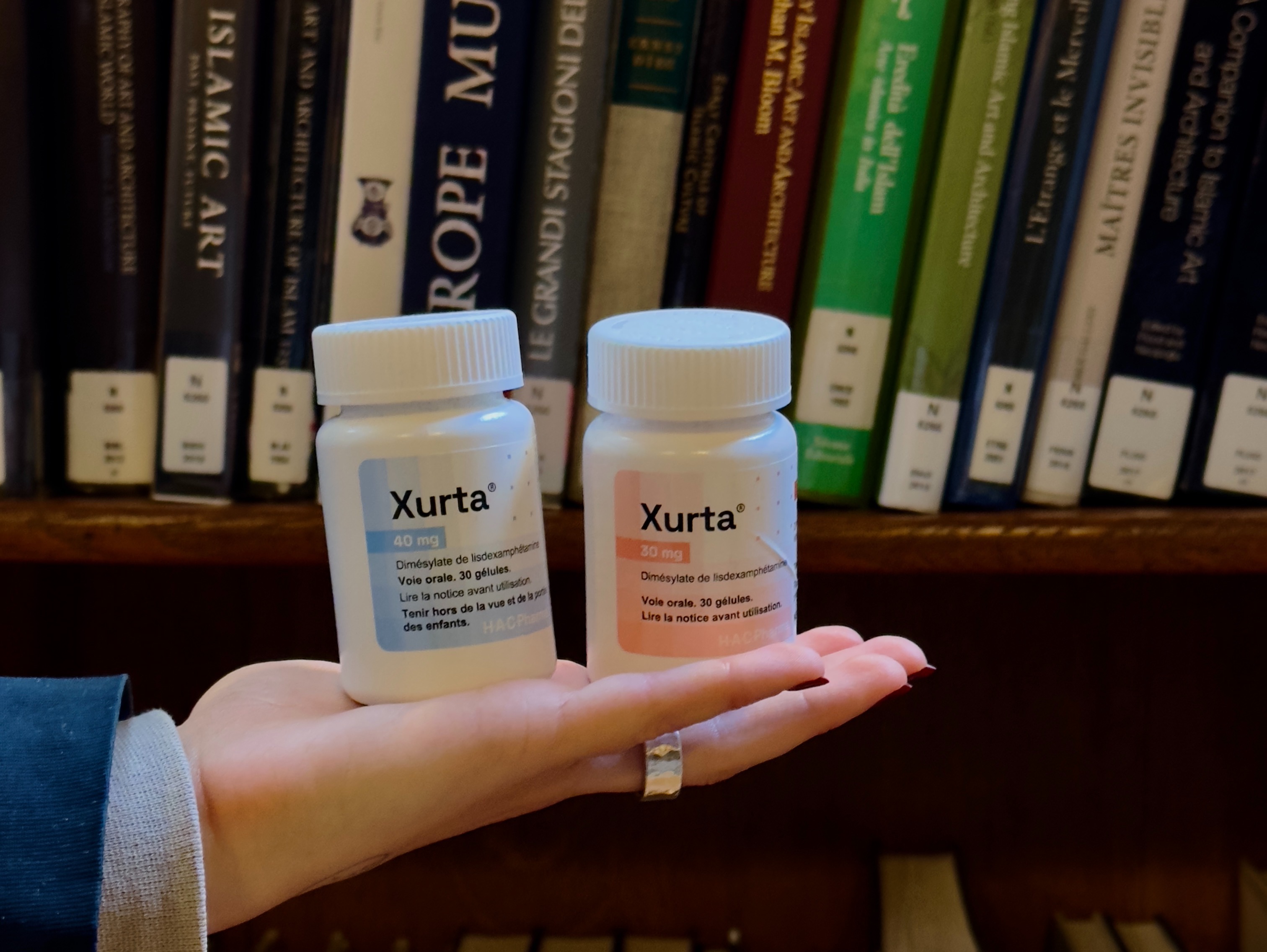
For most AUP students, acclimating to life overseas is a test in patience, including adapting to a new culture, new language and new bureaucracy. For people with ADHD, however, that learning curve is even steeper. That routine back home, seeing a psychiatrist, restocking on a prescription medication, finding medication that works, can easily become a maze of regulations in France.
Attention Deficit Hyperactivity Disorder (ADHD) is a neurodevelopmental disorder characterized by deficits in attention, impulsivity and emotion regulation. It’s frequently misunderstood and can, depending on your country, be bewilderingly overmedicalized or severely underdiagnosed. In the U.S., ADHD is heavily diagnosed and treated, with both therapy and medication, but in France, cultural skepticism has for decades curtailed diagnosis as well as access to treatment.
Although Vyvanse is one of the most commonly prescribed medications in the United States, its French equivalent, Xurta, was only approved six weeks ago and remains difficult to obtain. Most pharmacies do not regularly stock it, and many psychiatrists are reluctant to prescribe it.
I wasn’t diagnosed with ADHD until my senior year of high school. I took it for the first time, came home and cried to my mom because for the very first time in my life my mind was quiet. I thought, that’s how "normal" people must feel. Arriving in France, that grounding dissolved. Trying to find a psychiatrist who would listen, speak English and understand ADHD was more than a behavioral disorder was exhausting.
"They Don't Believe Us"
For Fiona Langan, an AUP student who has been diagnosed with ADHD since she was 17, that hesitancy feels personal. “I’ve been to countless psychiatrists here in Paris,” Fiona says. “Each time they either don’t believe me, force me to show them pages and pages of medical records from America or even try to give me natural alternatives.”
She’s not alone. Among international students, stories like Fiona’s are shared in hushed tones, of incredulity and paperwork, endless waiting that can cause students to feel the legitimacy of their need called into doubt.
A Deep Cultural Divide
To get to the bottom of why France continues to resist treating ADHD as the U.S. does, an interview was conducted with Dr. Dominique Padoux, a psychiatrist in Paris who has many American patients. He is not apologetic about his trade.
“I have a very low opinion of the vast majority of my colleagues,” he said. “And they are bad because the teaching they have when they specialize in psychiatry is bad. They are content with the very insufficient teachings they’ve received.”
In this case, Dr. Padoux refers to the French psychiatry’s decades long commitment to psychoanalysis, a field devoted to early childhood and talk therapy, which has often overshadowed conditions such as ADHD.
“French child psychiatrists were horrified that in the U.S. children are treated with medication derived from methamphetamine,” he explained. “They were so shocked that they decided not only that it was bad, but that it didn’t exist. So, ADHD didn’t exist for forty years.”
By “medication that is based on methamphetamine,” Padoux means the basic energizer of the narcotic crystal meth — or how drugs like Adderall are derivatives of methamphetamine, chemically speaking. While its medical form is neither particularly dangerous nor unregulated, that association has been used for years to direct fear and stigma around a drug perceived as dangerously addictive rather than helpful in France.
The irony, he added, is hard to ignore.
“It’s quite paradoxical. ADHD was discovered in France at the beginning of the twentieth century by a French psychiatrist, Dr. Georges Paul Dupré. We discovered it—and then we denied it.”
Padoux says that the resistance is scientific and cultural. For decades, French psychiatry has given priority to analysis while American psychiatry decided to use medication instead. "They don't say it openly," he stated afterwards, "but because they think ADHD is a cultural export from America, many French psychiatrists reject.
Between Two Extremes
The split between the U.S. and France is not just medical, but ideological. Dr. Padoux also said part of France’s hesitancy in embracing ADHD comes from an uncomfortable relationship it has had with American psychiatry.
“They don’t say it openly, but French psychiatrists resent the hegemony of American psychiatry,” he said. “So they do the opposite. Where American psychiatry prescribes too easily, French psychiatry refuses too easily.”
For American students studying abroad, this creates a paradox. In the States, ADHD treatment can feel industrialized — appointments are brief, prescription renewals happen fast. In France, access is so severely restricted that many well-documented patients have a hard time finding a doctor who will agree to help.
“When I started focusing on ADHD twelve years ago,” Dr. Padoux recalled, “only a few hospitals in Paris were allowed to prescribe. They were overwhelmed, so the law changed to let private psychiatrists treat ADHD. The problem is, most of them have no idea what they’re doing.”
Since 2021, France has revised its rules so that individuals as well as clinics can now prescribe ADHD medication. In this way the overworked public clinics can be alleviated somewhat at least. Yet problems remain, doctors themselves are hesitant still and there isn't a lot of medication on hand to help. To me, the law looks good on paper, yet in practice reforms are still lagging behind.
The outcome? Students feel torn between the two systems, one that rushes to medicate, and one that turns a blind eye.
As someone who has experienced both systems, I often feel like I can only stand in frustration. In the US, I sometimes felt I was being reduced to a diagnosis, a fast prescription, getting a refill, "see you next month." Here in France, I am constantly needing to prove that diagnosis. It's a strange space to be, to know that the medication changed my life, yet in a country where people still doubt its necessity having to justify it all the time.
From the US side, Dr. Candace Burnham, a psychologist in California, says that the two situations can exist side by side. “There’s a lot of overprescribing that happens in the United States, especially with stimulants,” she said. “People can get addicted, especially to Adderall—but Vyvanse is actually considered a non-addictive drug.” She adds, “Two things can be true. Overprescribing happens in the U.S., but there’s also greater awareness and understanding of ADHD. Stimulants are a valid and necessary treatment for people who truly need them.”
Dr. Burnham also points out how when students lose access to medication abroad, it can have a really serious impact on their lives. “If a student has been on medication for a long time and suddenly loses access while adjusting to a new country, it can make everything harder—academics, organization, even basic self-care,” she said. “It’s not just about schoolwork; ADHD affects every part of life.”
A Slow Shift
Despite his opinion, Dr. Padoux acknowledges signs of progress within the system.
“Young people know more about psychiatry than most psychiatrists,” he laughed. “They learn from TikTok, Reddit, Discord—they are informed, and they ask questions. That’s new in France.”
He sees the approval of Xurta as a long-overdue correction.
“The French government is aware that we’re late,” he said. “Too many people who would be better off medicated are not treated. That’s why Vyvanse—Xurta—was finally approved.”
For him, Vyvanse represents a chance for balance.
“Adderall has given ADHD medication a bad name—it’s harmful in many cases,” he said. “But Vyvanse is different. It’s effective, balanced, and in my opinion the best available.”
While Adderall and Vyvanse are both stimulants, they act on the body in different ways. Adderall is fast-release and can be habit-forming, while Vyvanse is a slower-release “prodrug,” meant to discourage abuse and provide more even sharpness of focus. This difference helps explain why France does approve Vyvanse, but still restricts a number of other ADHD drugs.
Though the approval of Xurta is progress, few psychiatrists are willing to prescribe it. For students, that means the wait goes on, hopeful, but not sure.
The Search for Middle Ground
Yes, ADHD is real, and for many students it’s a debilitating condition if not properly treated. But its increasing presence in the United States, and the seeming casual ease with which it can be prescribed, has led to skepticism across the globe. The result is a kind of tug of war between two systems of belief: One that medicalizes all things, and one that fears medication.
Students like Fiona, and many others at AUP, are in limbo. They move through two systems that each fail them, though in opposite ways, one through excess, the other by neglect.
The aim shouldn’t be to take sides, but to achieve a middle course where diagnosis is thoughtful and treatment accessible. ADHD drugs aren’t a Band-Aid, nor is it a cultural fad. For those who, in all sincerity, need it, it’s a lifeline to stability, focus and self-understanding.
A Call for Understanding
As awareness about ADHD gradually increases in France, the level of understanding among medical professionals and students themselves has also increased. The conversation is changing, from skepticism to understanding, from denial to nuance.
For American students going abroad, that shift can’t happen soon enough. For now, sailing my way through ADHD in Paris requires me to walk the tightrope of hope and frustration, tenacity and patience.
Because sometimes, being unmedicated isn’t an option, it’s a symptom of a system that hasn’t yet learned how to listen.