We Went to Shen Yun in Paris So You Don’t Have To
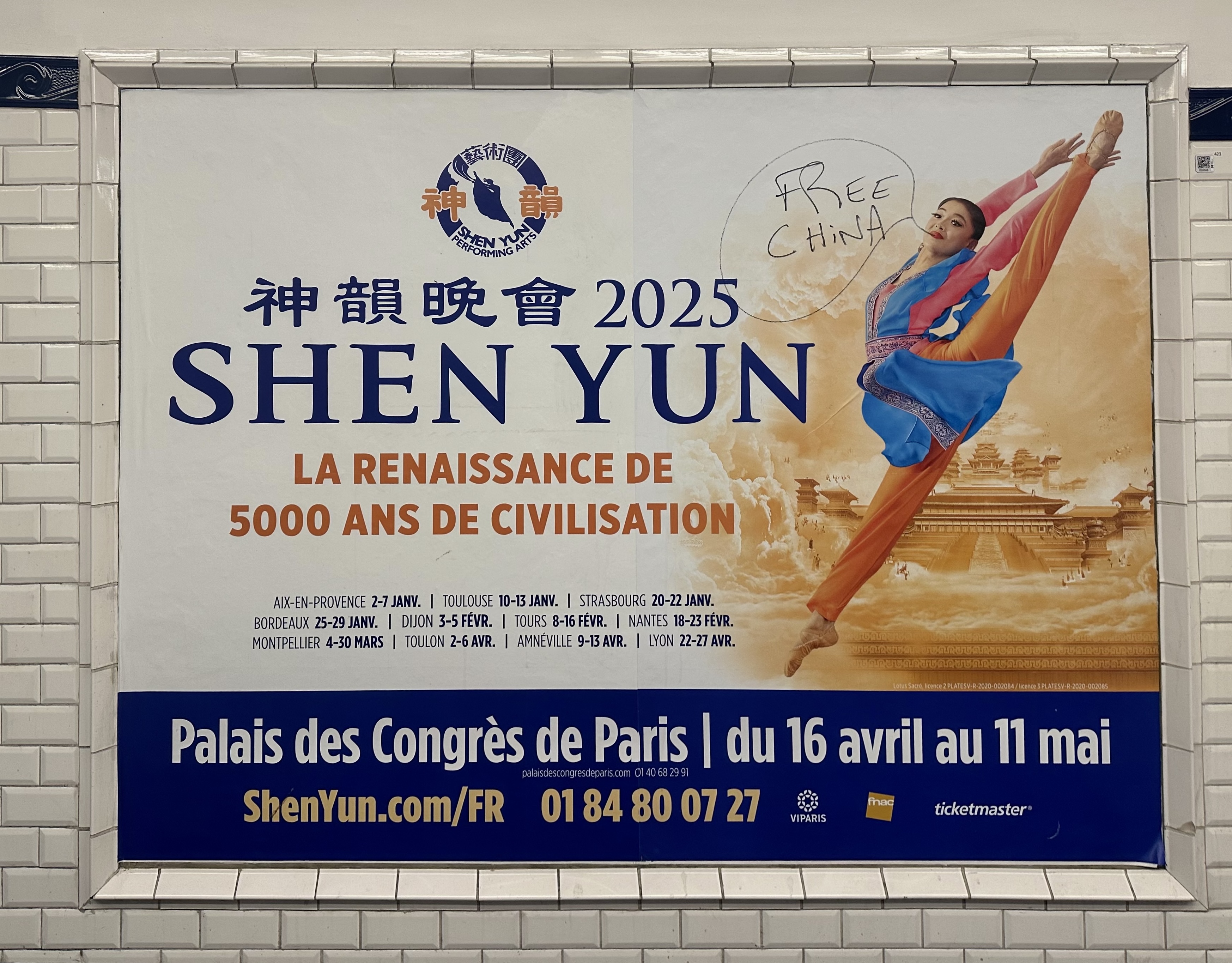
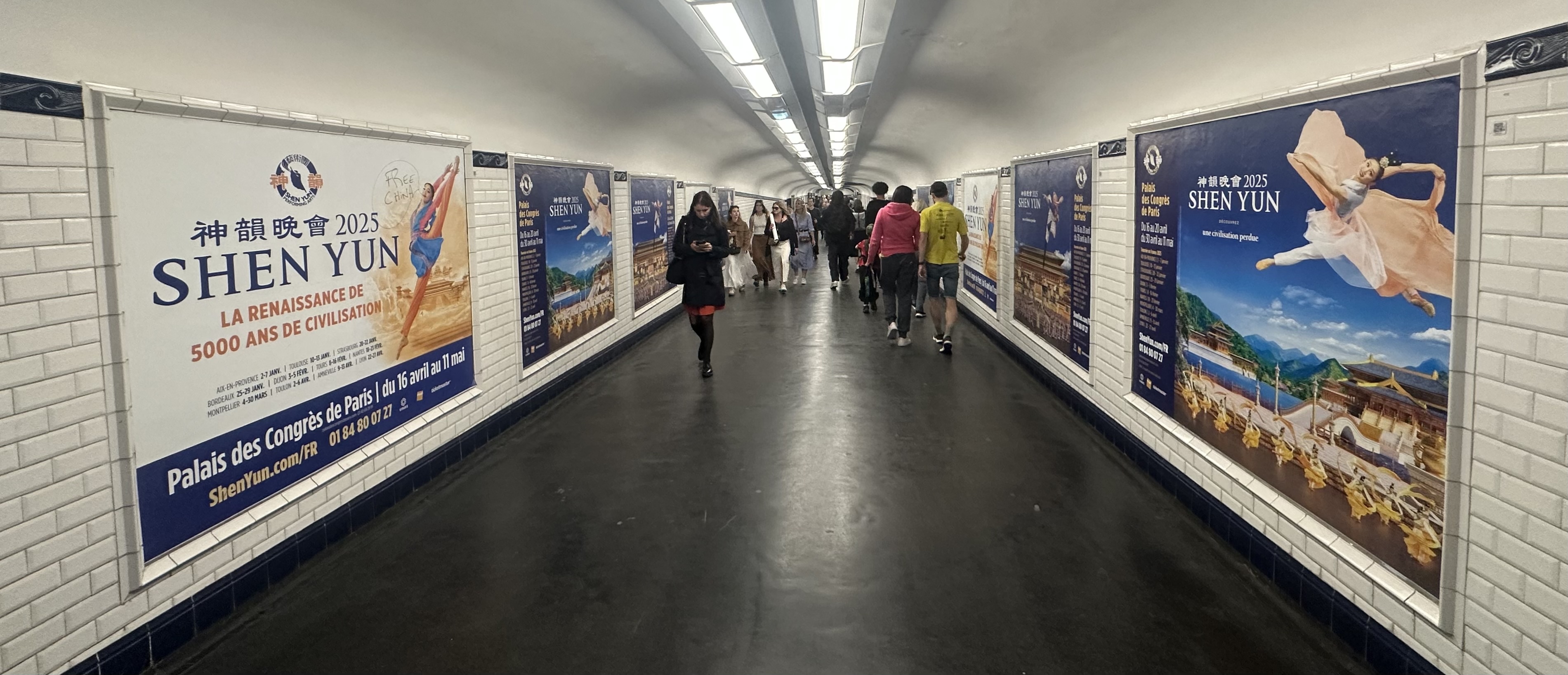
Year-round, the image is hard to miss: poised dancers in silk robes mid-leap, golden lotuses blooming beneath them, smiles frozen in divine serenity. In Paris, Shen Yun’s advertisements adorn metro corridors, bus stops and the windows of corner cafés and tabacs. The same is true across major cities—New York, Los Angeles, Chicago, Miami—where the troupe’s technicolor billboards and social media ads flood public and digital spaces alike.
The ads promise “China before communism.” Naturally, we were intrigued. But alongside the glossy image, there’s a steady undercurrent of controversy. The Embassy of the People’s Republic of China in the U.S. has repeatedly denounced Shen Yun as an anti-society cult, accusing it of spreading anti-China propaganda. More substantively, a 2024 investigation by The New York Times uncovered troubling accounts from former performers, detailing emotionally abusive training practices, minimal compensation and pressure to perform through serious injury. The same report also alleged that Shen Yun’s leadership sought to arrange marriages between foreign performers and American citizens in order to secure U.S. visas. These revelations complicate the show’s polished exterior, prompting deeper questions about what audiences are really seeing when they attend a Shen Yun performance.
So, what is Shen Yun really? Who goes to these performances? Does the show live up to its advertisements? Is it truly a celebration of Chinese culture, or something else entirely? Whether Shen Yun is a sincere cultural project, a spiritual recruitment tool, a propaganda vehicle or perhaps all three, it draws global audiences year after year. We set out to review the 2025 Paris production not just for its art, but also for the layers beneath it: ideology, narrative and intent.
On opening night in Paris, Wednesday, April 16, 2025, we attended the spring season debut at Palais des Congrès, opting for the cheapest tickets (€75, seats near the back). We went not only to review the show’s artistic merits, but also to critically assess the organization behind it. For an international and Paris-based readership, we offer this first-hand report on what has become one of the world’s most visible, mysterious and controversial touring productions.
Some initial assumptions turned out to be off. Based on the advertisements, one might expect a modest turnout or a performance that leaned more on spectacle than skill. But the theater was nearly full, and the dancing proved far more technically impressive than anticipated.
So, What is Shen Yun?
Founded in 2006 by Falun Dafa (or Falun Gong) practitioners in New York, Shen Yun Performing Arts is a non-profit that presents itself as a revival of China’s pre-Communist spiritual and cultural heritage. Its name, combining “Shen” (divine being) and “Yun” (rhythm), evokes the image of divine beings dancing. The company promotes traditional Chinese culture while drawing attention to the persecution of Falun Dafa followers through artistic performances.
The company comprises hundreds of performers from across the globe: dancers, musicians and singers hailing from places including Taiwan, North America, Australia, Korea, Germany and Armenia. According to promotional pamphlets distributed at performances, Shen Yun has eight companies touring more than 130 cities annually, with appearances at prestigious venues like Lincoln Center in New York and the Kennedy Center in Washington, D.C. Millions have attended its performances. Beyond its global reach and commercial success, Shen Yun presents itself as more than just entertainment; it is a mission-driven production with deeply political and spiritual roots.
According to Shen Yun and backed by reports by Human Rights Watch, they created the troupe in the U.S. to escape religious persecution and revive traditional Chinese values forbidden by the Chinese Communist Party (CCP), which banned Falun Dafa in 1999 and continues to suppress it harshly. The story behind Shen Yun becomes clearer when you examine its connection to the group that created it.
Shen Yun is a performing arts project of Falun Dafa, a spiritual movement founded by Li Hongzhi in the 1990s. Li has described the performances as a way to “save” audiences spiritually. Though Shen Yun presents itself as an independent cultural enterprise, it shares ideological and financial ties with The Epoch Times, a media organization also founded by Falun Dafa followers.
According to The Epoch Times’ official website (accessed June 2, 2025), the outlet was created by practitioners “from diverse backgrounds” to expose what they describe as the Chinese Communist Party’s “human rights abuses” and its efforts to “subvert Western societies and fundamental freedoms.” Despite claiming to be politically independent, the outlet takes a strongly anti-CCP stance and promotes a conservative worldview under the motto “Truth, Tradition, Hope.” Both Shen Yun and The Epoch Times operate under the broader umbrella of Falun Dafa and rely heavily on its global network of volunteers for fundraising, publicity and logistics.
In March 2020, Los Angeles Magazine journalist Samuel Braslow reported in a since-removed article titled “Inside the Shadowy World of Shen Yun and Its Secret Pro-Trump Ties” that Falun Dafa had aligned itself with far-right U.S. politics, backing pro-Trump digital media campaigns and spending millions on Facebook ads, many later taken down for spreading misinformation and being linked to fake account networks.
Shen Yun is deeply tied to The Epoch Times and the broader Falun Gong movement, which has evolved from a fringe, spiritually motivated group into a powerful force in right-wing media. Over the past few years, the paper has embraced pro-Trump narratives, election denialism and conspiracy theories, fueling massive revenue growth—up 685% between 2019 and 2021. Central to this transformation is Falun Gong’s leader, Li Hongzhi, who views the media as a weapon in a supernatural war against communism. Shen Yun and The Epoch Times both operate within this network, blending religious ideology with conservative political messaging. Their approach relies heavily on aggressive marketing, polished branding, and the spread of misinformation to reach and influence older conservative audiences in the U.S.
Shen Yun and Falun Gong’s political entanglement raises concerns about transparency, especially given Shen Yun’s public image as a purely cultural endeavor. In a time of heightened political polarization in the U.S., the group's efforts to obscure its ideological affiliations, while continuing to operate as a mainstream entertainment act, invite scrutiny.
Furthermore, the founder of Falun Dafa himself has made controversial claims, such as that aliens invented modern technology to corrupt human minds. While Falun Dafa denies being a cult, critics, including former members and journalists, have pointed to its rigid hierarchy, charismatic leadership and apocalyptic worldview as troubling features. Nonetheless, its fierce opposition to the Chinese government remains the group’s ideological cornerstone, and Shen Yun serves as one of its most public-facing vehicles.
The Ideological Core of Shen Yun
Falun Dafa is a spiritual meditation practice that claims to be rooted in Buddhism with two major components: “self-improvement through the study of teachings, and gentle exercises and meditation.” The movement is spearheaded by Li Hongzhi, who founded Falun Dafa and is referred to as the “teacher” or “master” of the practice. He consistently writes new teachings that are posted on the Falun Dafa website. During these performances, renditions of classical Chinese stories are told, such as Wu Cheng'en’s Journey to the West, in addition to politically charged, anti-communist dances depicting Falun Dafa-based persecution.
Dafa is a “Chinese Buddhist” term defined as “‘Great Way,’ ‘Great Law,’ or ‘Great Teaching,’” when translated. The book Zhuan Falun, published in 1995, serves as the practice's doctrinal scripture, detailing the practice’s main beliefs. In its introductory chapter, “On Dafa”, it states that Dafa is the “wisdom of the Creator [...] the bedrock of creation, what the heavens, earth, and universe are built upon,” going on to explain that Dafa “encompasses all things, from the utmost minuscule to the vastest of the vast, while manifesting differently at each of the cosmic body’s planes of existence.” This means that Dafa encompasses everything from subatomic particles to celestial bodies.
Zhuan Falun dictates that through enlightenment, individuals will both understand the makeup of the universe and experience “elevation” of their “moral character.” It is in this chapter that the “qualities” of Dafa are identified and defined: zhen (true and genuine), shun (good and kind) and ren (tolerant, composed, forbearing and patient). These qualities are seen on the front of Falun Dafa pamphlets handed out at Shen Yun events and on their website. Li Hongzhi teaches followers that advanced practitioners of Falun Dafa will develop supernatural abilities, such as being able to levitate and see through walls.
Developing beliefs of Falun Dafa and Li Hongzhi has led to a more apocalypse-centered approach to his teachings, citing that “Dafa is here to save people at the end times,” and “its manifestation in the human world is to save people during the end times.”
Shen Yun, rooted in the practice of Falun Dafa, claims that, starting in 1999, tens of millions of people publicly practiced Falun Dafa in China. This widespread following, according to Shen Yun, left the Chinese government unable to control this newfound ideology. This marked the beginning of the “nationwide persecution campaign” targeting Falun Dafa. In addition to the arrest and torture of Falun Dafa followers (which has been cited by the Human Rights Watch), the practice was labeled as an “evil cult” on the front pages of CCP (Chinese Communist Party) controlled newspapers. Falun Dafa followers were also sent to labor camps.
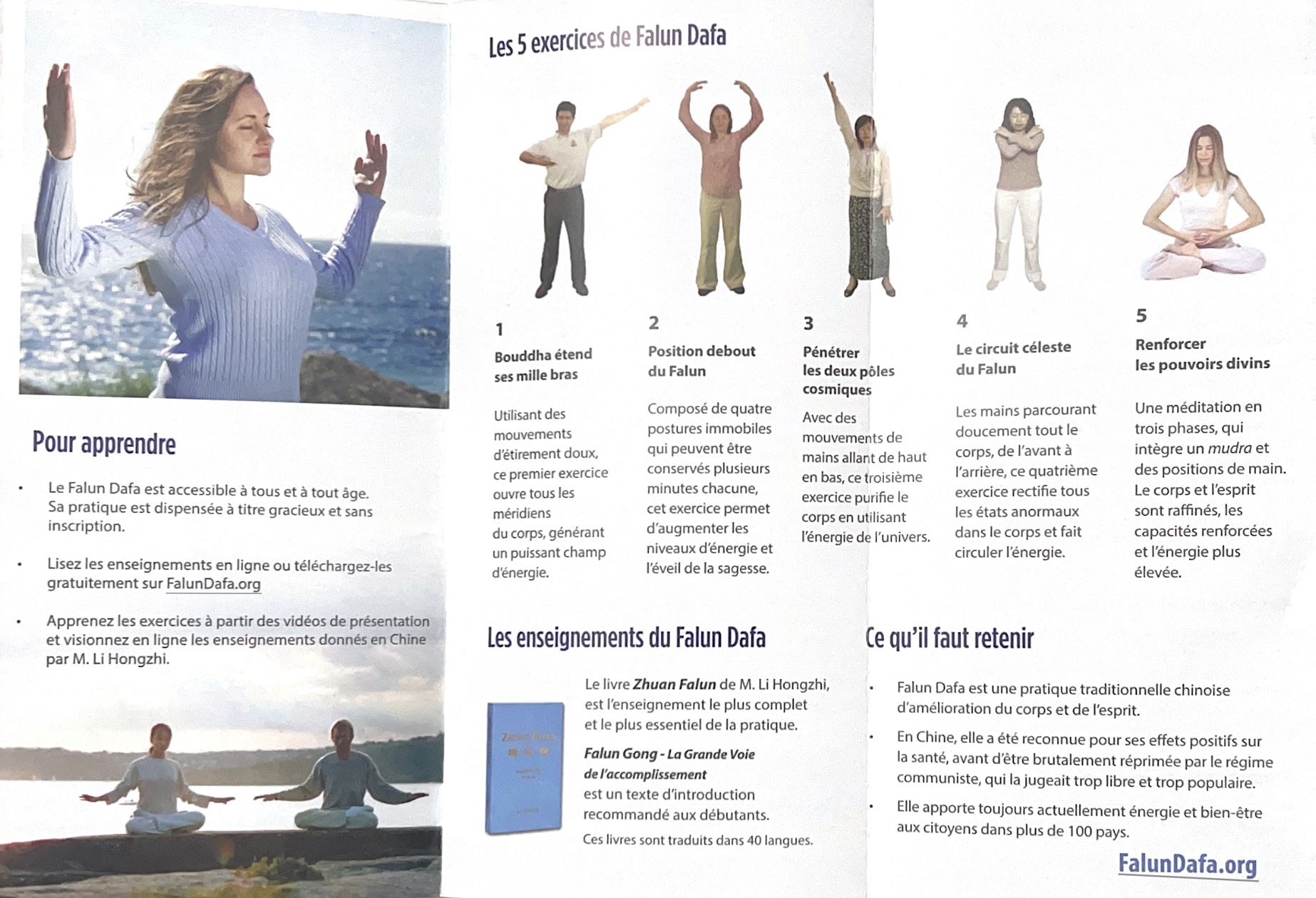
Falun Dafa promotes the return to “ancient Chinese spiritual practices”, with its Information Center stating that to evade persecution by the CCP, these practices have been repackaged this “ancient philosophy into innocuous, secular-sounding exercises generically called 'qigong' (literally 'energy work'),” which are tai-chi like in nature. During the Shen Yun performance, one of the emcees stated the mission to return to traditional culture, elaborating that this traditional culture cannot be found in China.
Falun Dafa also promotes anti-communism, with the tagline “China before Communism.” The slogan appears prominently on their website and at protests, where practitioners hold banners and distribute anti-CCP pamphlets.
Within the Shen Yun performance, a dance sequence is devoted to the persecution of Falun Dafa practitioners by the CCP. The dancers depicted a Falun Dafa practitioner being arrested and beaten in prison. It is in this dance that Chinese state police are attempting to harvest to organs of the Falun Dafa believer. This goes hand in hand with real-life accusations by Falun Dafa of organs of their believers being harvested by China. These accusations come after decades-long concerns that the Chinese government harvested organs of executed prisoners, which were harshly denied until 2005 when the Chinese government admitted to the harvesting, though they deny that any are taken from Falun Dafa practitioners.
A second CCP-centered performance, titled “The Creator has arrived”, is set in Shanghai and features a Chinese state police officer returning to tradition, vis-a-vis getting hit by a car and Falun Dafa practitioners healing him just in time for an apocolyptic-esque flood to hit Shanghai and the Falun Dafa believers being saved via levitation by Buddha. Shen Yun makes it clear that by rejecting communism, you will find salvation, even at the “end times.”
Two other beliefs of Falun Dafa that are reflected in Shen Yun performances are anti-Atheism and anti-evolution. The dances and songs performed change each year, with one of the songs featured in the 2025 show titled “Dafa rayonne dans le monde” or “Dafa shines in the world.” The lyrics seemingly reject modernity and its mores, with the following (translated by Google Translate):
"Modern thoughts and actions block the way
Dogmas of evolution and the absence of gods, arrogance of demons
These are potions of forgetfulness to prevent one from returning to Heaven
Protect tradition, preserve your benevolence
For the Creator has arrived"
The song manages to blatantly and simultaneously oppose the “absence of gods” and the “dogmas of evolution” to steer people in the direction of “returning to Heaven.”
The Visual Experience of Shen Yun
Visually, Shen Yun is a dazzling spectacle. Every detail, from movement to music, serves a purpose beyond entertainment. The dancers perform with striking precision, their formations synchronized and expressions deeply emotive. Much of the choreography emphasizes lightness and grace, with floating movements, spinning jumps and gravity-defying leaps. Gender roles are reinforced through the storylines of traditional Chinese folklore, but also through the choreography: female dancers move delicately with fluttering sleeves and soft gestures while male performers execute martial arts-inspired routines with stomps, kicks and acrobatic tumbles. These contrasts uphold traditional gender binaries and present them as natural and harmonious.
Costuming also carries symbolic weight. Bright pastel garments typically adorn characters representing traditional values or spiritual purity, while darker tones are reserved for villains, often depicting modernity, atheism or communist authority. The palette communicates a moral dualism that leaves little ambiguity about who the heroes and villains are.
One of the most distinctive aspects of the show is its digitally animated backdrop, which interacts seamlessly with the performers. In one scene, celestial beings such as Buddhas or Taoist deities fly across the screen before dancers in identical costumes leap from backstage, giving the illusion they have sprung from the digital realm onto the stage. These effects, while technically impressive, also serve a symbolic purpose, blurring the boundary between divine intervention and earthly struggle and reinforcing the narrative that Falun Dafa adherents are spiritually chosen or protected.
The performance is accompanied by a live orchestra that blends Western classical instruments with traditional Chinese ones like the erhu and pipa. Musical choices are just as calculated: sweeping crescendos mark scenes of moral or spiritual crisis, while cheerful melodies underscore depictions of pre-communist cultural harmony.
Shen Yun’s aesthetic excellence does more than entertain. The high production value and emotional weight in the choreography, costumes and music give the show a polish of cultural authority, encouraging audiences to accept its worldview as authentic rather than politically or ideologically motivated. Its global reach, cult following and roots in Falun Dafa further solidify this legitimacy in the eyes of those unfamiliar with the group’s beliefs. The beauty of the production becomes a vehicle for belief, using visual and musical cues to subtly and at times overtly deliver a worldview framed around good and evil, tradition and modernity, spirituality and corruption.
The Audience
As we walked into the amphitheater in the Palais des Congrès in the 17th arrondissement, we were surprised by how full and large the theater was. When researching, we found that the theater held 3,723 people. The Epoch Times states that all 88 shows in France were sold out, with 210,000 audience members present in the performances throughout the 12 cities in France where Shen Yun performed.
The show itself was narrated by two emcees, with narration provided in English, French and Mandarin, allowing for different demographics in the audience to understand and enjoy the nuance of the show, while also explaining to us that Shen Yun anticipates these key demographics will be present even in a European city.
Conclusion
In the end, Shen Yun delivered a stunning and technically impressive performance. But as the show progressed, its underlying ideology became more apparent. Rather than presenting its message upfront, the production gradually wove in spiritual and political themes, revealing a deeper agenda beneath the surface.
Would we recommend going? If you have no qualms about supporting what is considered to be a child rights offending cult, then yes. Despite the jarringly blunt song lyrics detailing whether your atheism will keep you out of heaven, the show is genuinely entertaining, with its vivid and artistic detailing of traditional Chinese mythological stories. Shen Yun places its ideology in the center of its artistic orbit, illustrating these beliefs through dance and song. Depictions of CCP-facilitated persecution, the saving of the soul through deity worship and how the return to Chinese tradition will save them in the end times are key themes of the show. This can be both concerning and intriguing to those who aren’t easily swayed by strong and biased messaging, or find it to be a third thing: entertaining. The ideology could be considered a bit outlandish, yet it is the same deeply held belief system that fuels cult-like groups.
After the show and during intermission, viewers were able to go to the hall outside the theatre to get pamphlets, program booklets detailing all the performances within the show, buy Chinese artisanal items and order Chinese food. Both bāozi, a bun that is typically filled with meat, and yēróng nuòmǐ or ‘coconut pearl’, which is a glutenous rice ball filled with custard, were topped with coconut shavings and came in both the original custard flavor and a chocolate flavor. The food was extremely tasty, with the meat in the bāozi having been well seasoned, with the yēróng nuòmǐ cí providing enough sweetness to end the meal on a high note. The food’s existence alongside the show itself adds another level of authenticity to the experience that Shen Yun may be trying to achieve. Some people (Alicia) may even find the food, accompanied by the entertainment of the show, to be good enough of a reason to go back. The pamphlets distributed promoted Falun Dafa and its exercises, which shows an attempt to ease audience members into physically engaging with Falun Dafa in addition to attending Shen Yun performances.
In regard to Shen Yun’s presence in Paris, the troops' presence in more than one French city does highlight the aforementioned widespread practice of Falun Dafa that brought on their persecution, an event cited by Shen Yun itself, though it seems that Falun Dafa and Shen Yun are widening their target demographic.