Love Without Subtitles
Like many Americans abroad, I met my French boyfriend on a dating app. For years, I was on-and-off dating apps in both the United States and Europe, stuck in a constant cycle of downloading, deleting, and re-downloading the applications from my phone. My online messages with these potential romantic partners varied based on our specific conversations but always remained cute and flirty, and importantly, they remained in English.
When I moved from New York City to France almost three years ago, dreaming of finding love, I thought I was ready for the romantic challenge of speaking to a partner in my non-native language. As a fluent French-speaker who had studied the language for over twelve years, I was confident in my speaking and comprehension abilities, however, I quickly realized the French used by Gen Z on dating apps was very different from the language I had learned in the classroom, or with my seventy year-old host parents.
This language difference intimidated me, and even though I wanted to prove that I could "hang" with the French speakers of my generation, I often chickened out and accepted when the conversations online would ultimately switch into English as a result of potential suitors wanting to show-off their English skills to l'americaine.
When I matched with my future boyfriend, however, it was different. I initiated our conversation, sending him the first message in French. In response to a photo of him in a black turtleneck and trench coat (very Parisian, I know), I wrote, "J'aime beaucoup ton style."
As I anxiously awaited his response, I started to craft several messages in my head, opting for witty responses that would show off my personality as well as my French ability, even though I mostly expected the conversation to eventually switch into English as it had with all the other French people I had matched with. His response, however, was in French, and three weeks later, that was the language we continued to use in the never-ending text conversations that led up to our first date.
(Not so) Lost in Translation
One and a half years into our relationship, my boyfriend and I still predominately speak to each other in French. I love being able to express myself romantically in more than one language, but trying to connect with a partner whose native tongue is different than your own also poses some challenges. Unlike in a film or TV show, you can't just switch on the subtitles to get a little extra help understanding what the other person is saying, especially in the moments you may need it most, like during an argument, or in more intimate situations, when studied slang or academic expressions just won't cut it, and pulling out a dictionary is out of the question.
When we started dating, I was terrified to mess up a conjugation or the gender of a word, internally criticizing myself whenever I made a mistake in French. However, as we grew more serious, I learned to embrace my faults and turn them into a learning opportunity, attempting to take mental notes during all the times my boyfriend (mostly kindly, although sometimes annoyingly) corrected my grammar.
Occasionally, I still need to open the translation app on my phone and type in a text message from my boyfriend to make sure I understand 100% of what he's said. Other times, I'll switch to English halfway through a conversation because I'm either too tired, or because the French words won't catch up fast enough to the English thoughts I'm trying to express.
I'm lucky that my boyfriend understands English and can speak the language very well, taking away some of the pressure to always perform my best in my non-native tongue, but since our relationship started en français, I try to maintain that as our base for communication. Overall I would say that the breakdown in our household is around 80% French and 20% English, but like all relationships, these roles aren't static. One day, the breakdown can look more like 60% French and 40% English, or even 70% English and 30% French. It depends on how we are feeling that day, and what one person needs from the other.
I'm not the only person at AUP, or in Paris, in a cross-cultural relationship where partners speak more than one language to each other. To learn about other experiences in these relationships, I spoke with two other multilingual couples living in Paris, discussing the perks, the challenges and the learning experiences of speaking with a partner from a different linguistic and cultural background.
Gillian and Quentin
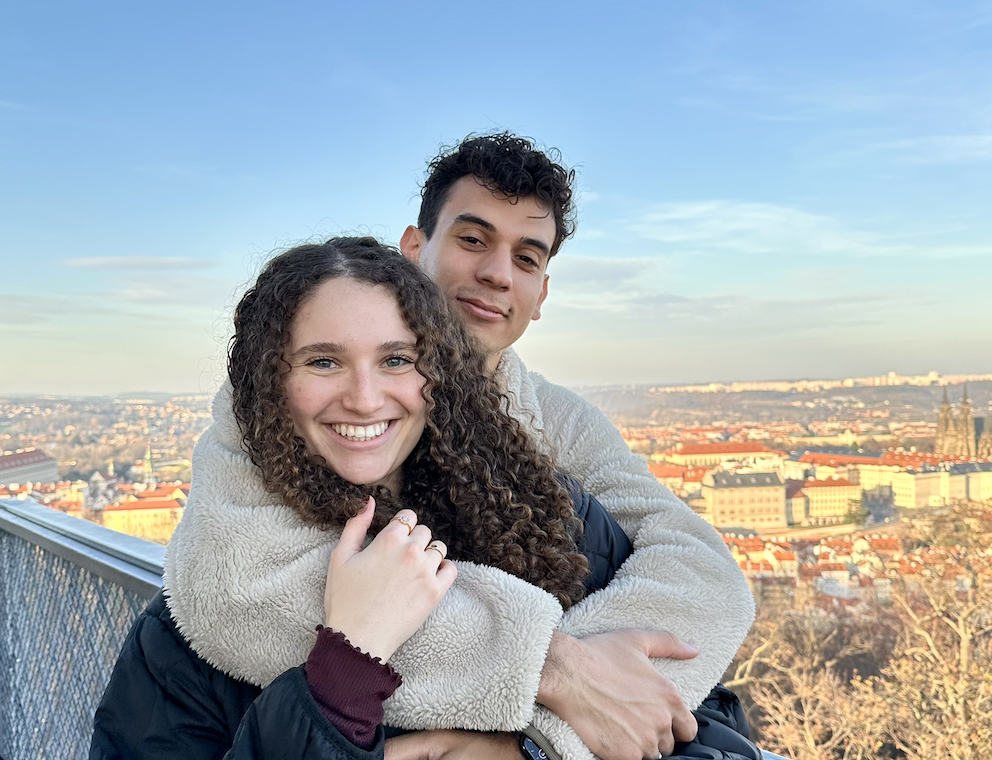
Gillian is an American master's student at AUP who moved to Paris in 2024. She met her French boyfriend, Quentin, at a bar in Paris seven months ago. When Gillian first introduced herself that night in the bar, she spoke in French, however Quentin described that the conversation immediately turned to English after the initial introduction, "and she's still making fun of my accent," he joked.
In contrast to me and my boyfriend, the couple stated that English is the predominant language in their relationship, saying they speak it around 90% of the time. "When we speak in French, it's when we've decided that it's gonna be some kind of French day or when we have French people over and we're forced to," explained Quentin, "but I think we've only done one day fully in French."
"It just falls to the bottom of the priority list when life is busy," expanded Gillian as the couple discussed how they've become accustomed to their daily routines, noting the challenges in switching to another language that differs from the one in which the relationship started.
During my discussion with the couple, we bonded over the difficulties of switching back and forth between languages and trying to communicate in your non-native tongue. "There's been a few miscommunications where sometimes one of us will accidentally say something that is mean or a harsher wording than what was intended, and I'm like, what did you actually mean to say?" expressed Gillian.
Miscommunications can happen in any relationship, but a language barrier, even if it is small, can exaggerate their effect. Like Gillian and Quentin, my boyfriend and I have experienced many instances where one of us uses the wrong word, or isn't quite sure how to properly express the feelings we are trying to convey. Luckily, having a strong foundation of respect helps to reinforce trust, allowing both partners to feel comfortable searching for words or making mistakes in their non-native tongue, especially when trying to build a strong foundation for building a life in a new country.
"I love being in France. It's a priority to stay in France and get French citizenship and be fully integrated into society, and obviously you can't be fully integrated into society if you don't speak the language," said Gillian when talking about her hopes to continue her life with Quentin in France. "I have a built-in French tutor, which is great, so we keep saying that we're gonna make [speaking French] a priority and I think we should."
Josh and Pierre
The second multicultural couple I spoke with was Josh and Pierre. The two met on Hinge after Josh moved from his hometown in Miami to Paris for a master's program at a French university. Pierre is French, and Josh is American but was raised in a Spanish-speaking household.
When describing their relationship, Pierre said that they speak almost 100% in English, although they often switch between French and English when communicating over text. "To me, it's a chance to still be able to practice my English, even though I came back to France," said Pierre while reflecting on his move back to France after spending years living in the UK. He continued by saying that "it's really cool Josh can also understand French because sometimes I can't correctly express myself in English since I'm not a native English speaker, so it's nice that I have the opportunity to translate anything I want."
Like Gillian and Quentin, Pierre values having the opportunity to expand on his language capabilities through his romantic partnership. His boyfriend Josh elaborated on this topic saying, "a year in, I'm so glad that he actually does speak English, because, I think it helps the relationship in the sense that my school is in French and my life is mostly in French outside of this, and it's exhausting when I'm with friends in school where I'm struggling so hard to explain myself sometimes. So it's a nice escape from reality when I talk to Pierre and I don't have to stress."
A third language also comes into play in Josh and Pierre's relationship. "Spanish is definitely the elephant in the room," said Pierre when talking about his desire to learn and understand Spanish so he can communicate more easily with Josh and his family in their native tongue. "We've tried to speak in Spanish but it doesn't last long," explained Pierre, "we see each other only on the weekends so it's the days to rest after school and work, and with English I imagine that our brains are on rest mode and we don't want to spend the weekend practicing speaking Spanish and making extra efforts to understand each other."
Although speaking in your non-native language and having to adapt to new customs can be tiring, being in a relationship with someone from a different linguistic background can allow you to gain a more in-depth understanding of another culture. "You go more in-depth into the culture when you start dating someone and meet their family and see their differences," explained Josh.
However, while traditions may vary, certain key relationship perspectives are important to be aligned on. "We share all the important stuff in our relationship, like the same ideas and expectations," stated Pierre in response to Josh's comment. "There's definitely smaller things, like how we celebrate Christmas dinner, that are very different because we were raised differently, but on everything that is actually important and that matters in a relationship, we are aligned."

Love in a Foreign Language
Moving to a new country and starting a life in a new language can be scary. I used to think that being in a relationship with someone who doesn't speak English fluently would be scary too. However, now, I've been living in France for three years, and half of that time has been spent starting a new life in French with someone I love.
In her memoir, Lauren Collins writes about her experience learning French to better communicate with her husband who once told her, "talking to you in English is like touching you with gloves," highlighting the importance of finding a common ground when it comes to finding ways to express yourself to the people who mean the most to you.
You can't control who you fall in love with, but you can at least try to control how you communicate with them. So when it comes to falling in love in a second language, compromise and humility are key. Learning to speak a little bit of a new language can go a long way, and even the smallest bit of effort can show your partner you truly care.