AUP Faces Potential Legal Consequences due to ‘Systemic Neglect’ of Accessibility

As the new Rue de l’Université building is set to open its doors in January of 2026, AUP has sparked intensifying criticism among the student body for their approach to accessibility and accommodations for students with disabilities. In a promotional blog post from July 29, 2025, David Horn, AUP’s Director of Campus Planning and Facilities, boasts about the Rue de l’Université building, stating it is “enhancing and improving the [AUP] campus,” but all renders of the Rue de l’Université building depict a step that prevents students with disabilities from entering without assistance.
Sophomore Anton Strauch claims AUP “systemically neglects” accessibility and that AUP “is missing an opportunity to showcase the university as a place for all to thrive.”
Upon viewing the render of the Rue de l’Université building, Strauch “was completely disgusted” by the lack of accessibility inclusion, especially as they have former work experience with the prioritisation of accessibility. A former-Special Project Assistant for Comme des Garçons from 2019 to 2022 in Paris, Strauch navigated blending the fashion house’s avant-garde prestige with bureaucratic accessibility requirements.
“It’s just not that hard,” Strauch explained. “When you promote yourself as an inclusive institution, it is your responsibility to creatively promote an equitable space where everyone is visible.”
Since the grand opening of the Monttessuy building in 2021, all renovations at AUP have narrowly met accessibility requirements outlined in the French Code de la Construction et de l’Habitation - Article L. 111-7. The Code de la Construction et de l’Habitation outlines the requirements for new builds and renovations “owned by private or public persons” to be “accessible to all, notably persons with disabilities.”
All AUP campus buildings do meet French requirements for accessibility, on paper. As of October 2025, Combes and Quai d’Orsay (via the Combes entrance) are the only AUP buildings that allow students with disabilities to enter and exit the buildings without assistance. Contradictory to the information provided by AUP:
- The Grenelle building’s accessibility is dependent on the main entry gates being open, which is not guaranteed as the gate is controlled by the Mairie du 7ème.
- The Monttessuy building’s accessibility requires a portable ramp to be placed by the reception, which obligates students with disabilities to rely on others for help, leading to extreme safety risks.
- The Passage Landrieu building’s accessibility restricts students with disabilities to the ground floor only which makes the PL building’s accessibility limited.
- The Tour-Maubourg building requires students with disabilities to enter via the sloped, cobblestone garage entrance, again posing extreme safety risks.
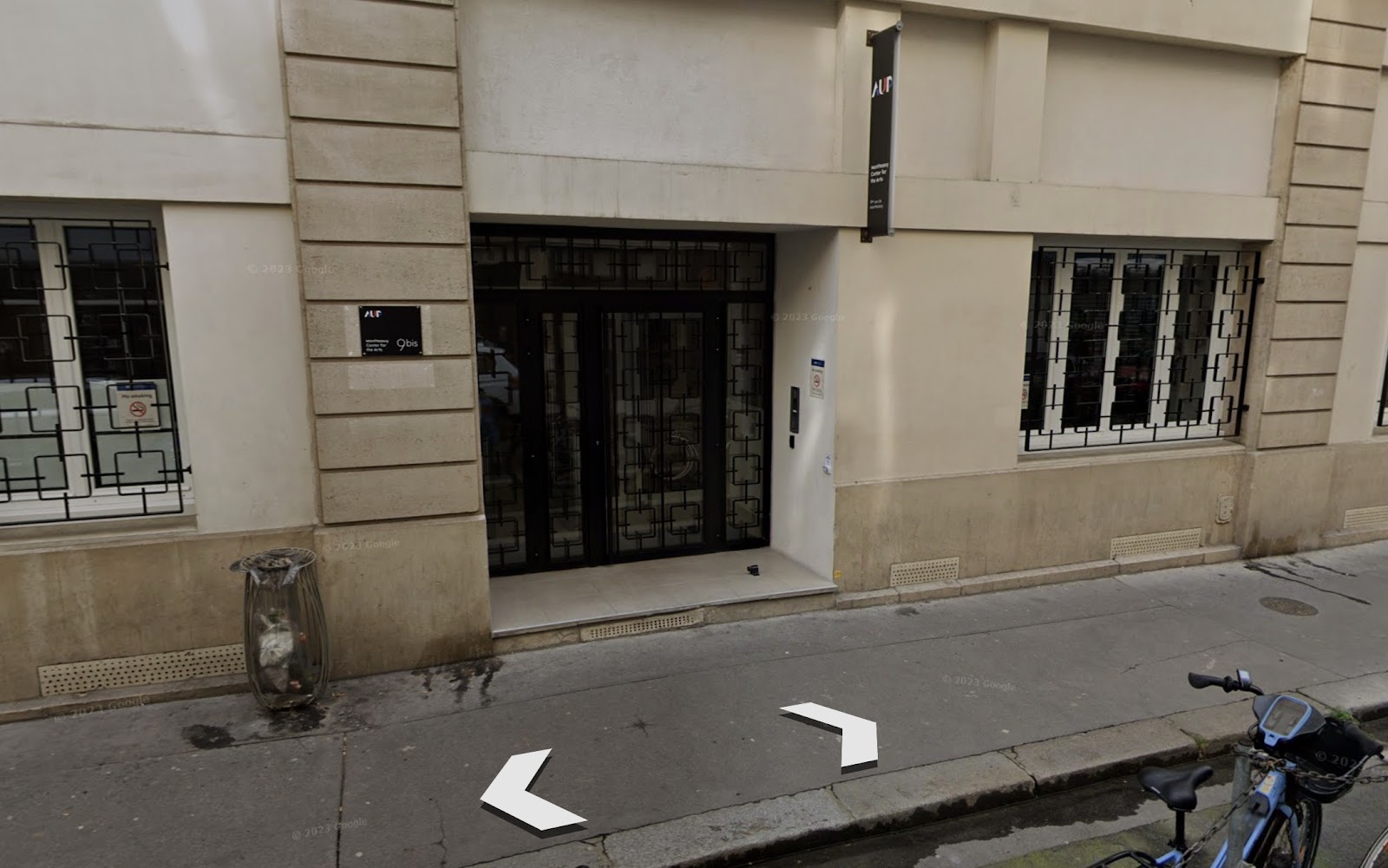
Under Article R162-9 of the Code de la Construction et de L’Habitation, AUP can face administrative sanctions, delays in the grand opening of the Rue de l’Université building and fines up to €225,000.
In conjunction with abiding by French accessibility laws, AUP is also obliged to follow American accessibility requirements. As outlined by 29 U.S.C. § 794, “any program or activity receiving [U.S.] federal financial assistance” is required to follow American anti-discrimination laws. Compared to French accessibility laws, The American with Disabilities Act (ADA) is far more strict and punitive towards institutions who fail to meet accessibility standards.
The ADA details exact measurements for ramps, doorways, and other infrastructure-related requirements to ensure accessibility. The ADA further outlines punitory measures for institutions who fail to comply with its standards. Under 29 U.S.C. § 794 and Section 504, American citizens hold the right to file a complaint against institutions receiving federal aid which would then initiate an investigation by the Office of Civil Rights.
Under 42 U.S.C. § 12188 (Title III), AUP can be fined up to $150,000 for violating accessibility laws. The Department of Education also has the right to suspend or terminate all federal funding towards AUP for its failure to comply with accessibility laws depending on the severity of AUP’s inaccessibility, resulting in students with or without disabilities losing access to federal financial aid. In the event of U.S. legal involvement, AUP runs the risk of losing credibility and accreditation.
Though the City of Paris and France, on a national-basis, have been subject to multiple UNESCO investigations for lack of accessibility, other French universities based in Paris outperform AUP in accommodating students with disabilities. A 23-minute walk away from 127bis Rue de l’Université, Sciences Po’s Disability Support Service, based at 13 Rue de l’Université, provides students with disabilities full tuition fee waivers, a guaranteed job or internship post-graduation—considering that people with disabilities in France face unemployment rates two times higher than the national average—and accessible housing accommodations specifically for students without disabilities.
In an interview with the Academic Resource Center (ARC), the AUP equivalent to a disability services department, Marytza-Leen Mompoint claimed, “There is a gap between what American law says and what French law says,” and that their job is to “take both laws and … review it and try [their] best to find some type of understanding.”
Rachel Webber, the Learning Accommodations Coordinator at AUP, confirmed that AUP must “abide by both countries’ laws” and that they “tend to lean towards the law [that] is more robust.”
When asked if they are consulted by Campus Planning on renovations, Mompoint explained that they “don’t necessarily, per se, get consulted.” In regards to the inaccessibility of Rue de l’Université building, Webber elaborated on Mompoint’s statement by stating that there was, in fact, a faculty town hall to discuss the Rue de l’Université building. Webber claimed she asked Horn about the accessibility of the Rue de l’Université in this town hall, to which she expressed disappointment in Horn’s responses stating, “[her nor Mompoint] have received any type of information or transparency,” regarding the accessibility of Rue de l’Université.
Webber criticised Campus Planning’s “reactive approach” to accessibility, and asserted that ARC’s power “is unfortunately not a whole lot,” but AUP’s current accessibility progress has been due to “[ARC] voicing a concern” after a situation had already happened.
Webber theorised that AUP’s approach to accessibility differs exponentially from other Paris-based universities because of “[AUP’s] less traditional … heritage” and that “[it] comes with growing pains and sometimes lack of understanding,” but that it “does not excuse the lack of services or awareness.”
Mompoint, an alumna of Sciences Po, further elucidated on the claims made by Webber, having stated that Sciences Po is a “deep rooted [French] institution” and that “whenever there was something egregious going on, [Sciences Po] was always [prepared] with a statement.” This, in turn, creates, what Mompoint hypothesised, “a culture of accountability [where] no matter what happens, [Sciences Po] has to come out and say, ‘okay, this happened’.”
Webber and Mompoint are optimistic in the improvement of AUP’s approach to accessibility, stating, “More and more of [the] leadership team is becoming aware of the growing need” for accessibility prioritisation.
When asked about her opinion on AUP’s approach to accessibility, AUP’s Provost Hannah Westley said, “We have to make sure our educational opportunities are accessible to all of our students … [but] we have challenges being where we are as a dispersed urban campus in the city of Paris.”
Westley, who began teaching at AUP in 2014, said, “AUP didn’t talk very much about student accommodations … but conversations surrounding it have been on the increase in all educational establishments over the past 10 years.” The Provost acknowledges there’s immense room for improvement in regards to AUP’s approach to accessibility, describing the approach as a “game of catch up” in a post-2020 social climate.
Like ARC, Westley is hopeful in the future of AUP’s approach to accessibility, claiming, “[AUP] financially, [is] in a more stable situation than [they’ve] ever been … and this has allowed us to consolidate the campus,” elucidating that this logistical stability “offers opportunities not just for easier access to students, but … it opens up different ways we [can] run our days differently.”
Both the Provost and ARC vehemently support students’ protests and calls for an AUP that is accessible to all. “At the end of the day, you can’t have a university without students … and [administration] has to listen to students,” Webber emphatically stated, as she simultaneously acknowledged the urgent need for this conversation as Offices of Civil Rights are forced to shut down at alarming rates in the United States.
“All of our buildings have to be compliant with American and French law … if [students] don’t feel like that is happening, they can write to David Horn, they can write to me, and they should,” the Provost asserted. “If I don’t know about it, I can’t do anything to change it.”
If you would like to voice your concerns regarding campus accessibility at AUP, you may contact:
Hannah Westley, Provost
David Horn, Director of Campus Planning
Rachel Webber and Marytza-Leen Mompoint, ARC