AI at AUP
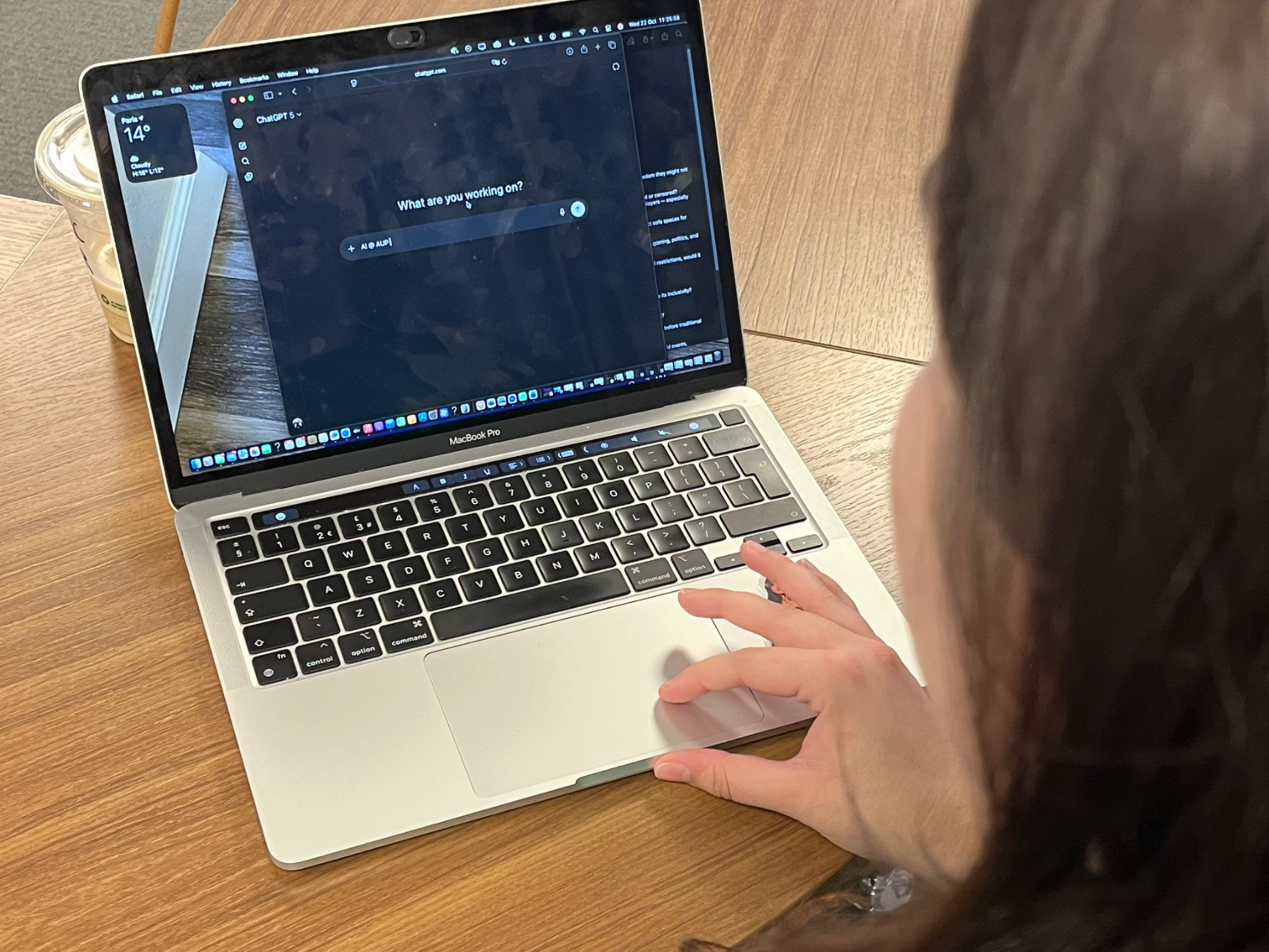
Artificial Intelligence (AI) is now a part of everyday student life. At AUP, faculty and students are exploring how AI can make learning more creative and efficient. However, they are also seeing how it can weaken academic integrity, motivation and authentic learning. The University's AI@AUP shows how AI is now just a new technology with easy access for us, but also a challenge for how students learn and how professors teach.
How AI Benefits Learning at AUP
AI can be a helpful learning partner when used with purpose. According to Washington State University's Provost Office, AI supports academic work by helping students "analyze complex work, improve writing and develop critical thinking" when used responsibly.
At AUP, many of these benefits are already visible and usable. The AI@AUP Summer 2025 Report describes pilot programs that give professors access to premium AI tools, such as ChatGPT Plus. These programs allow professors to experiment with lesson plans and design more interactive assignments. While students can use AI to generate ideas, review their grammar and receive feedback before turning in their work.
For some professors, AI's role is more complicated. Professor Friederike Windel, an assistant Professor in Psychology at AUP, sees both sides. "I don't see AI as a tool for learning," she says, "but it can support some academic activities. The classroom is a special place where we practice critical thinking and connect theory to real questions. AI cannot replace that kind of learning."
Her comment points out that AI may help surface-level work, but it cannot recreate the depth of discussion or reflection that happens face-to-face. So, while AI can be a great tool, that is how it should stay.
Dr. Windel even began adjusting her teaching to reflect this. “I’ve reduced assignments that are only about writing,” she explains. “Now I include creative and reflective projects, and I plan more in-class, handwritten activities. These allow students to think more deeply rather than just summarize.” By creating more reflective, hands-on work, she shows how professors can adapt teaching methods to protect meaningful learning.
AI also opens space for new kinds of learning. According to AI@AUP, AUP professors are developing ways for AI to support language learning and accessibility. One example is an AI French tutoring tool created to help students practice conversation. These projects show that, when used responsibly, AI can encourage creativity across the university.
How AI Can Harm Academic Learning
However, with the positives of AI, there are negatives. Not every use of AI is good for students. As The Guardian reported in their article about the harms of AI, teachers across the world are noticing that students who heavily rely on AI often begin to lose confidence in their own thinking. Essays written with AI may look well-structured, but often lack real substance. Some students have even described their AI-generated work as "hollow", perfectly formed sentences without true understanding behind them.
The same issue has appeared at AUP. The AI@AUP report mentions how many students use ChatGPT or other AI tools for work, without openly admitting it. Faculty claims this hurts classroom trust. Some professors have found that students arrive unprepared for discussions or submit papers that cannot even be explained. Even when AI usage is not considered cheating, it can still reduce real engagement in classroom environments.
Professor Geoffrey Gilbert, director of the Teaching and Learning Center agrees that the issue goes beyond plagiarism. “We need to imagine carefully what we mean by academic integrity,” he says. “To have integrity is to be fully engaged in education, to build skills and show mastery honestly.”
He warns that relying on AI too much can “short-circuit” learning. “Most uses of generative AI skip over the process of developing skills,” he explains. “But this depends on the field. In marketing or data science, students might need to master AI as part of their learning.”
Interestingly, Gilbert notes that many students think AI use is legitimate but still believe it hurts their learning. “That’s the paradox,” he says. “They see it as allowed, but they also know it gets in the way of real understanding.”
Finding Balance
With the pros and cons of using AI for work, our goal as students and faculty should be to make sure AI supports learning rather than replacing it. AUP is working on critical AI literacy, which means helping students think carefully about how they use AI. Classes such as First Bridge and First Year Success will talk about the ethics of AI, and the Writing Program will add lessons about how AI affects reading and writing. These actions show how AUP does not want to ban AI, but guide how we all use it, helping students live and learn in a world where AI is now heavily a part of our everyday lives.
Professor Gilbert adds that AUP’s liberal arts model allows professors flexibility. “A marketing class might use AI every day,” he says, “while a literature class might focus more on interpretation and writing. Academic freedom means trusting professors to set the boundaries that make sense for their field.” AUP also plans to introduce an AI Charter, created with the UNESCO Chair for AI and Human Rights, to guide the ethical use of AI across campus.
Learning With AI, Not From It
AI will continue to shape how students learn and professors teach. But at AUP, the goal is clear: to use technology in ways that enhance human creativity and understanding, not replace them.
As Dr. Windel puts it, "AI isn’t here to think for us — it’s here to remind us what real thinking looks like.” These conversations show that AUP is not banning AI but learning how to use it responsibly. This is to ensure students continue to think, create and learn as humans first.