
Chasing the Perfect Shot
Street photography is the art of paying attention to the world as it unfolds, unfiltered and often unseen. It asks for presence over perfection and instinct over control. In a world rushing past, it rewards those willing to slow down and observe before the moment disappears.
Henri Cartier-Bresson (1908–2004), often called the father of modern street photography, was a French photographer born in Chanteloup-en-Brie near Paris. A pioneer of candid, observational photography, he co-founded Magnum Photos agency and helped elevate photography to an art form grounded in timing, instinct, and presence.
He once said that taking a photograph is about capturing "the decisive moment", that fleeting second when everything aligns: movement, light, emotion, geometry.
“To me,” he said, “photography is the simultaneous recognition, in a fraction of a second, of the significance of an event as well as of a precise organization of forms which give that event its proper expression.”
Cartier-Bresson believed that “to take a photograph is to align the head, the eye and the heart. It is a way of life,” he said. Photography, for him, was not about staging but about intuition and presence.
That idea still holds true. Street photography is not about perfection. It is about being tuned into the world around you.The image either happens or it does not, and you only get one shot.
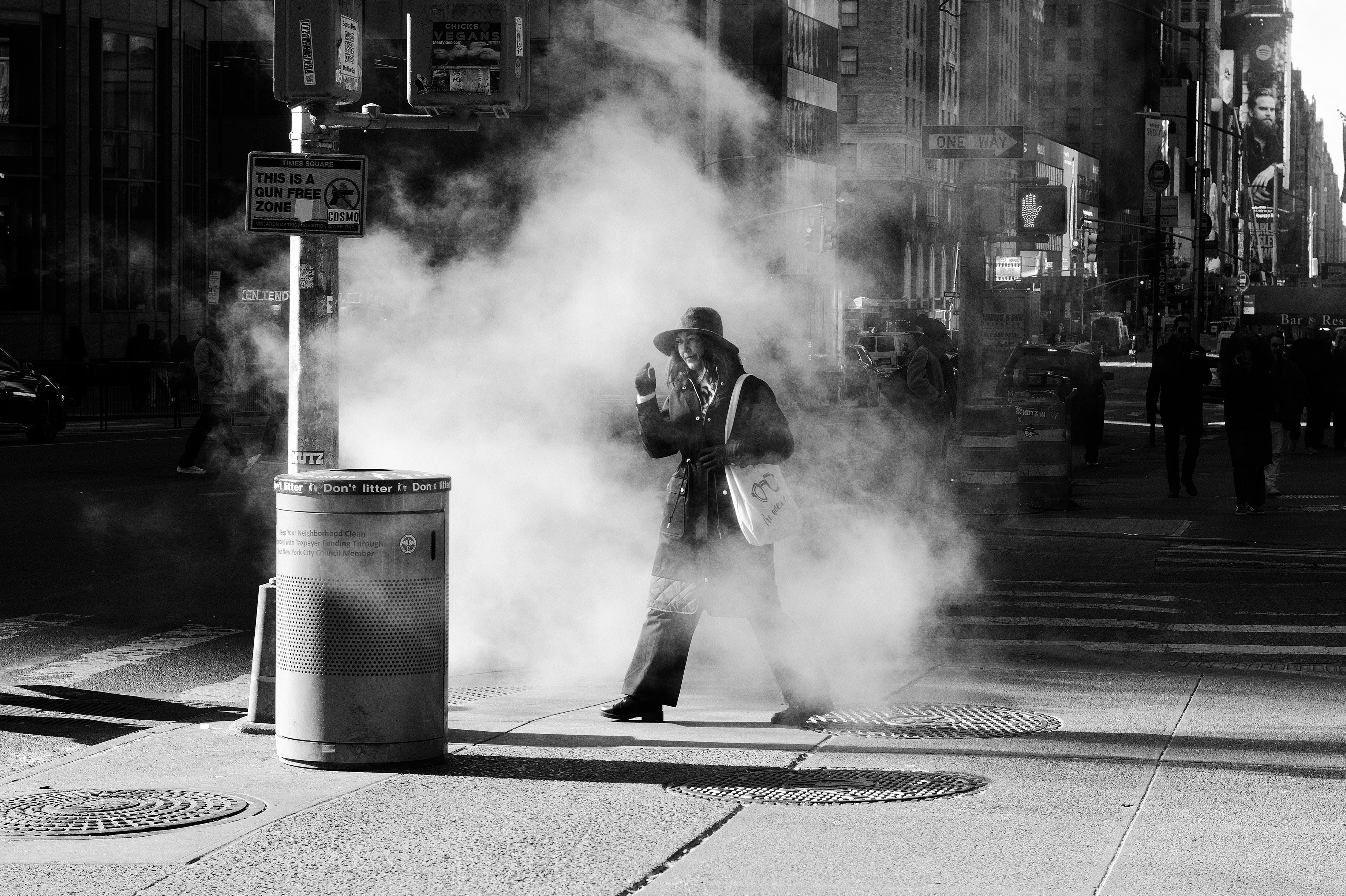
This philosophy carries into my own work. Several of the photographs featured in this article were taken on the streets of New York City, a place where everything moves fast and unpredictably. But sometimes the most cinematic moments happen in the blur.
The city breathes, literally, and you get these strange seconds when someone steps into the light, into the steam, and it all just clicks. I did not follow her. I did not wait. I just saw and shot.
This instinctive approach mirrors the technique of Robert Frank, the Swiss American photographer (1924 to 2019) known for his unfiltered portraits of mid-century American life. Like Cartier-Bresson, Frank relied on intuition, using a compact 35mm camera to stay agile and discreet in the streets.
He embraced available light, deep shadows, and unconventional framing, letting real life shape the photo. The result was an honest and at times unsettling reflection of what he saw, a kind of unfiltered clarity that helped reshape how photography was understood.
Cartier-Bresson’s idea of the decisive moment still resonates today, but it involves more than simply being prepared to press the shutter at the right time. It is also about recognizing and responding to the visual tension that emerges in that brief instant.
When movement, light, and emotion converge within the frame, there is a subtle interplay between the elements, a kind of push and pull that gives the image its power. The stillness of a person’s expression, the motion of a passing crowd, the tension between shadow and light, and the geometry of the surrounding space all contribute to a quiet, unfolding drama.
Each of these visual components adds depth to the scene, but it is their interaction, their collision and contrast, that generates tension and drives the narrative forward.
Street photography often reveals more than just what we see at first glance. You might catch someone’s stride, the geometry of the street, a fleeting expression.
But what about everything else that surrounds that moment? The noise of the city, the thoughts running through the person’s mind, the stories behind their expression. These unseen elements contribute to the depth of the image, even if they are not directly visible.
What makes an image resonate is not only its composition but the emotional residue it leaves behind. A good photograph lingers. It raises questions. Who is this person? Where are they going? What just happened, or what is about to?
The frame becomes more than a record of time; it becomes a space for imagination, where the visible world brushes up against the invisible one.
Not All Street Photography Is Loud
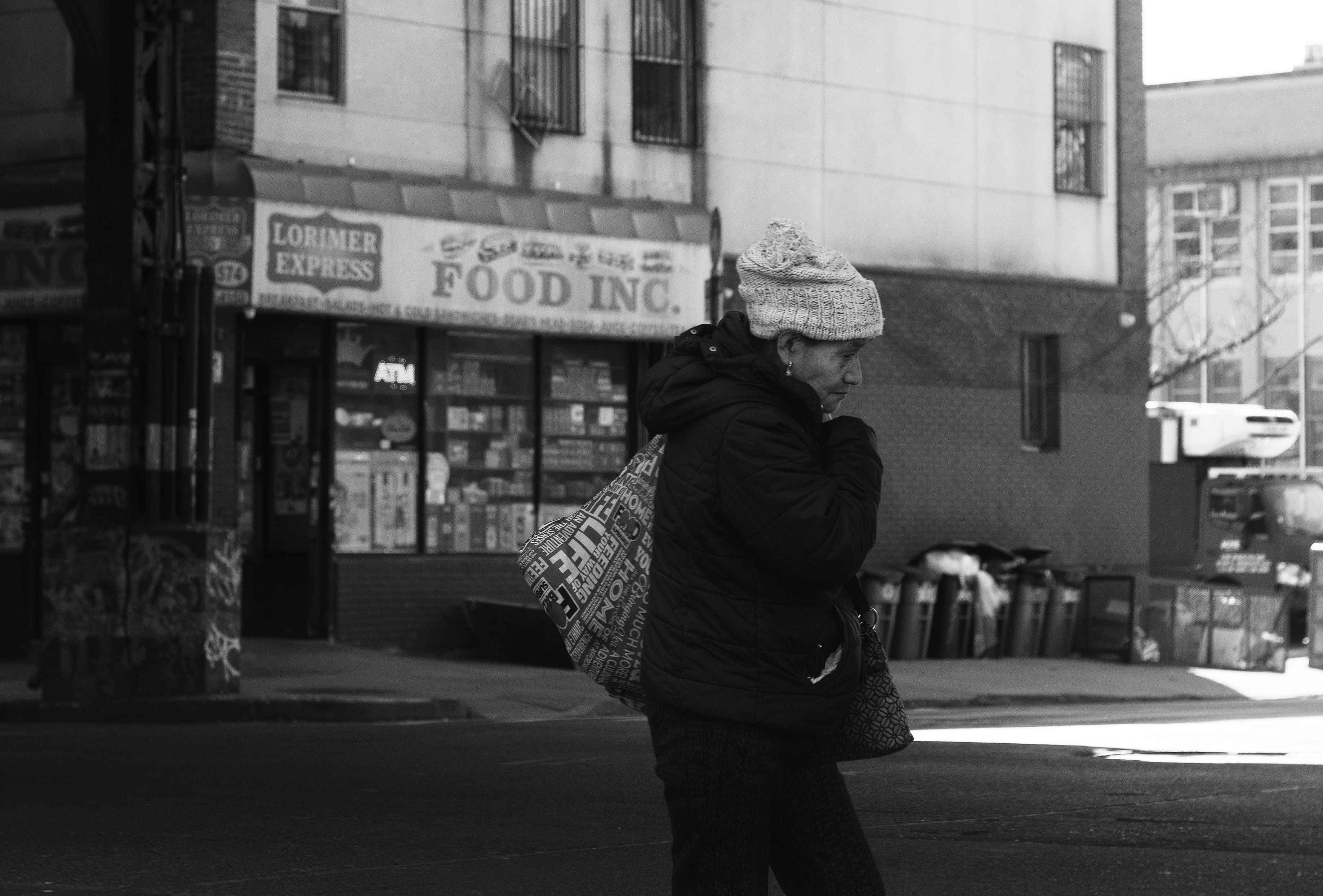
The moment was gone in seconds, but her presence lingered in the light and shadow. Image credit: Alexandra Peña Jimenez
Not all street photography is loud. Some moments whisper. A look, a gesture, the way someone holds themselves while crossing a street, every detail holds a weight of its own.
In the photograph above of a woman walking past a corner store in Brooklyn, there is no direct interaction, no awareness of the camera. She did not see me. She was simply in her moment, and I happened to be there. It felt intimate, but distant. Observational, but personal. Capturing that unobserved pause became its own kind of connection.
That’s what makes this kind of photography so rewarding. You don’t control the scene, you just wait for it to unfold. And when it does, it doesn’t ask for permission. It just happens.
Vivian Maier (1926 to 2009), an American street photographer born in New York City and raised between the United States and France, captured this spirit beautifully. Her vast archive of street photographs, largely discovered after her death, reveals quiet moments of daily life through a Rolleiflex twin-lens camera she held at waist level. Shooting from a low, discreet angle, she preserved small gestures, glances, and fragments of time often overlooked.
Her quiet attention to the unnoticed helped shape the way I move through the street today. I do not approach photography as a search for drama, but as an act of paying attention. To light, to posture, to the silence between things.
There is something almost sacred in that silence between photographer and subject. It is not about stealing a moment. It is about bearing witness to something unrepeatable. Maybe she was lost in thought; maybe not. The beauty is that we will never know.
For just a second, everything aligned. The light, the colors, her stride, her expression. There is a kind of humility in recognizing that the image does not truly belong to the photographer. It was not constructed or arranged. It simply appeared and was preserved in that fleeting moment.
The Power of Observation
To better understand the balance between instinct and intention, I spoke with Professor Tatiana Grigorenko, a visual artist and professor at The American University of Paris. Though her current work leans more conceptual, she began as a street photographer, and still considers it the foundation of how she sees the world.
“I wouldn’t say it’s just about seeing quickly—it’s about being aware of your surroundings,” she told me. “It’s not just looking, but actually seeing. Especially nowadays, we do a lot of looking but we don’t do a lot of seeing.”
She believes this kind of observational practice is more relevant than ever.
“So much of how we consume images today is about performance, how we want to be seen. That’s why street photography feels so important. It’s about seeing others without filters and letting yourself be seen too. That’s where life happens.”
This philosophy does not belong to one city or one pace of life. Whether in a place that moves quickly or one that asks for pause, the quiet act of noticing reveals something universal.
The Quiet Geometry of the City
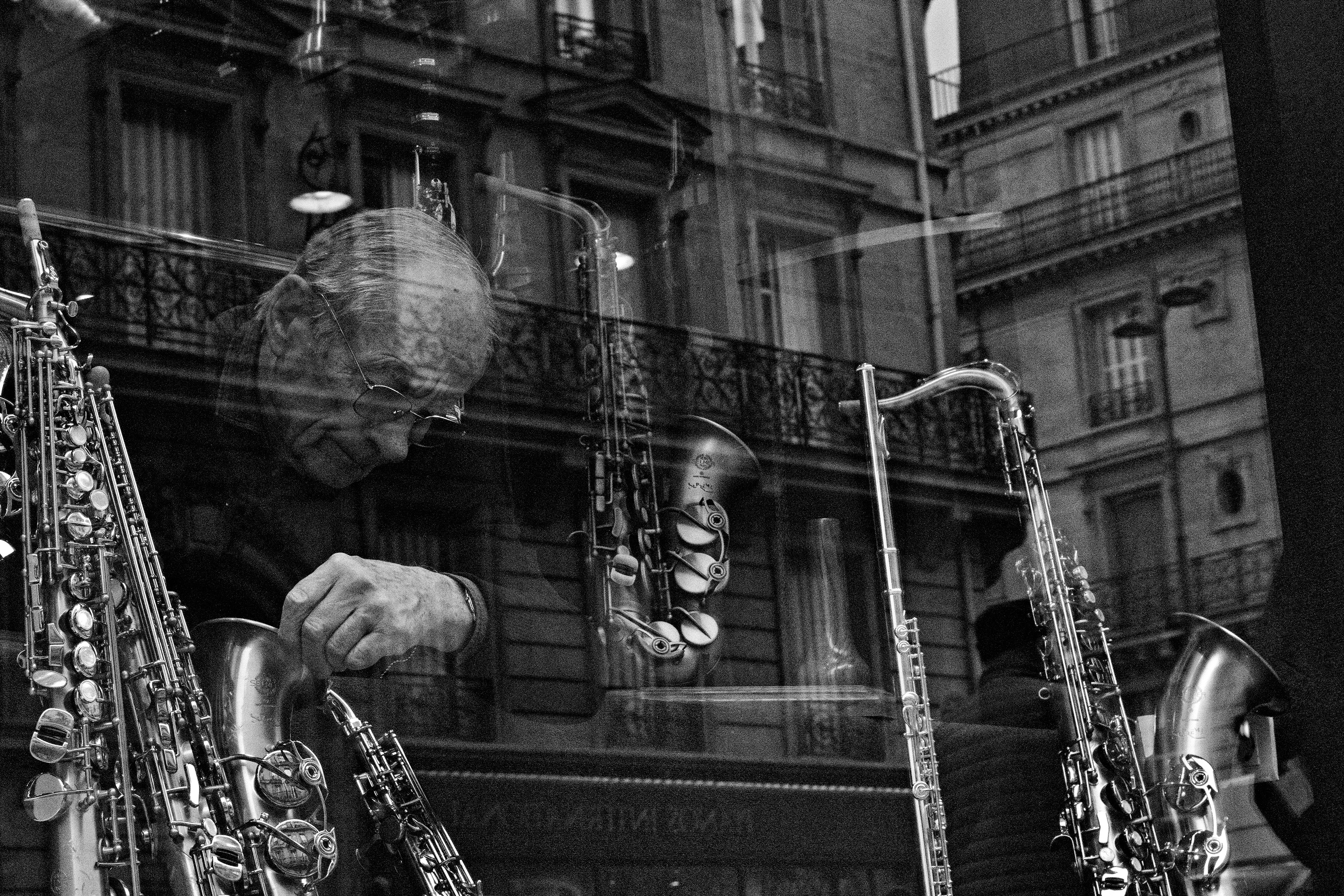
Though New York’s pace is fast and brash, Paris brings a slower, more reflective rhythm. Both cities, however, offer moments where the real story unfolds in the space between what is seen and what is felt.
I caught this moment just walking past a music shop. What struck me was not only the man and his saxophone, but how the street outside folded into the glass. The city layered itself into the frame, one world inside and one outside, both colliding without touching.
It felt like two stories happening at once. One grounded in reality, the other in reflection. The man arranging instruments, unaware of being observed, and the mirrored blur of passersby in the glass are a reminder that in street photography, as in life, presence is always doubled. There is what we see, and then there is what slips by just out of reach.
This layered composition is a common technique employed by Gary Winogrand (1928 to 1984), a street photographer born in the Bronx, New York. His photographs often revealed complex urban scenes filled with overlapping gestures, expressions, and points of focus.
Meaning was not found in a single subject, but in the interaction between many. His visual language embraced the chaos of public life and turned it into something rich with rhythm.
Winogrand’s style was fast-paced and instinctive. He moved through the world with a 35mm camera, shooting quickly to catch fleeting moments as they passed. His photographs felt immediate and unposed, filled with energy but never forced. One example of this approach can be seen in his photograph Los Angeles, 1969, where multiple figures and actions merge in a single frame.
That kind of layering creates its own story, one that reveals more each time you return to it.
Street photography is a constant negotiation between intention and accident. The frame can reveal more than you realized you saw in the moment. Fragments, shadows, echoes of stories you didn’t know you were telling. That’s the magic of it. The best images leave space for questions, not just answers. They’re invitations, not conclusions.
Whether it’s the grit of New York or the quiet geometry of Paris, the real power of a photo isn’t just what it shows, it’s what it reveals after the fact. You don’t always know what you’re chasing. But when you catch it, you do.


