
Becoming Bob Dylan
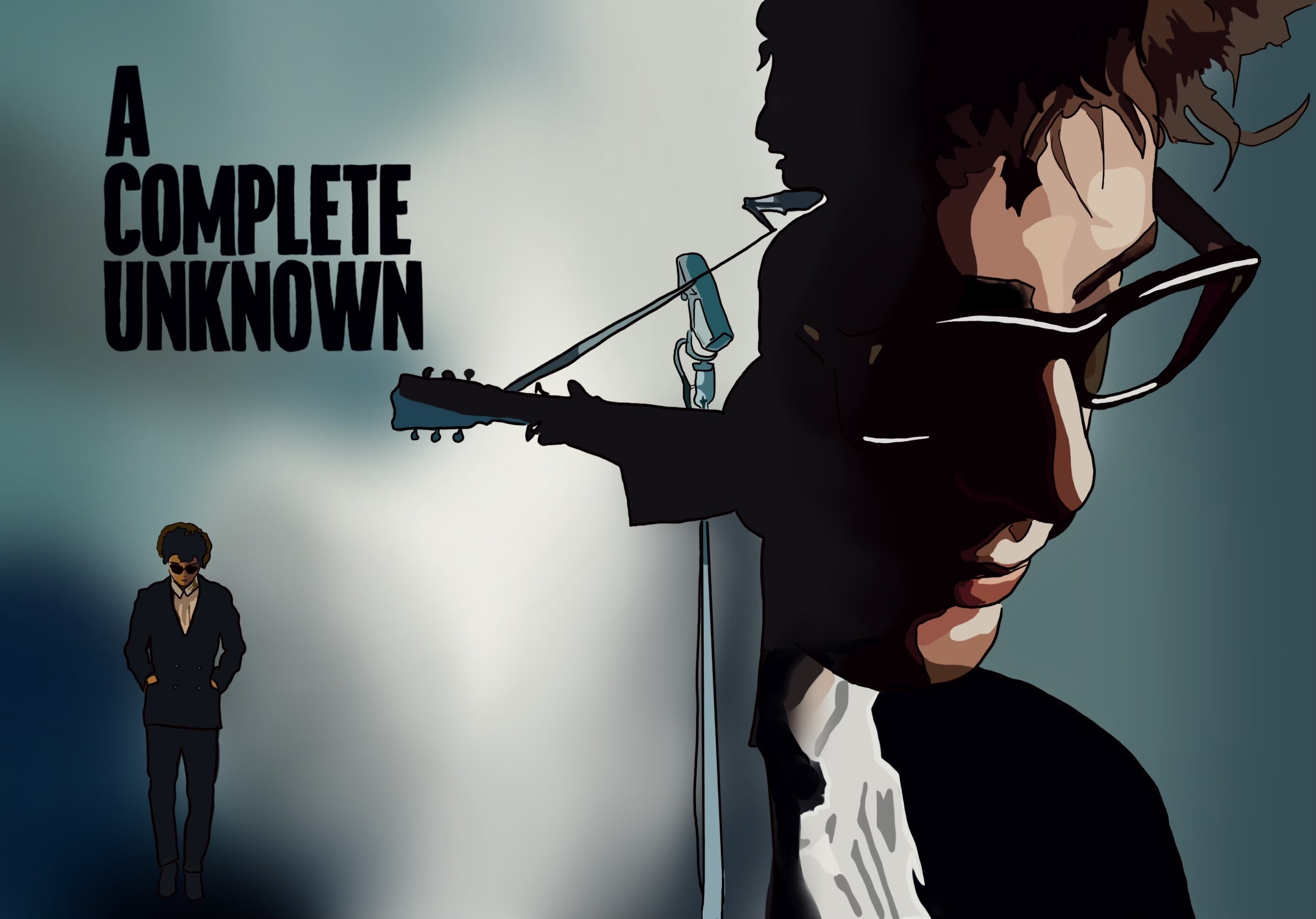
Timothée Chalamet, who plays Bob Dylan in the recently released biopic A Complete Unknown, was originally given four months to become Dylan, but "thanks in part to a pandemic and a few Hollywood strikes, he’s had five years”, according to Rolling Stone magazine. Each actor may exercise different methods when becoming their character, but when they are engrossed in the world of another individual for years at a time, the line between self-identity and the person they are portraying starts to blur.
Throughout Timothée Chalamet's dedicated preparation, method acting techniques and his continued embodiment of Dylan's persona post-production in public life, he demonstrates how fully committing to a character can blur the lines between performance and identity—raising questions about the lasting impact of deep role immersion on an actor’s sense of self and actual brain chemistry.
An Intense Preparation
With Chalamet’s most recent film, A Complete Unknown, he took the method-acting approach. Chalamet truly absorbed all the techniques and lessons from Dylan’s life, completely disconnected from the world around him to step into this character.
Chalamet's exhaustive preparation process consisted of working with a vocal coach, guitar teacher, dialect coach, movement coach and even a harmonica instructor. The approach to his preparation was fully immersive. For instance, he brought his acoustic guitar to singing lessons where he’d sometimes, "without warning, show up talking in Dylan’s voice,” Rolling Stone explained.
Chalamet insisted that the music needed to be properly felt and performed, and to do that he couldn't just re-create it in a studio but needed to perform it live. He explained that if “[he] was singing to a prerecorded guitar, then all of a sudden [he] could hear the lack of an arm movement in [his] voice,” highlighting the physicality and intricacies of Dylan’s performance style.
His preparation went beyond classroom lessons. During filming, Chalamet even went three months without using a cell phone to avoid “losing a moment of discovery as the character” and to be more accurately in the time of Bob Dylan, a time without iPhones. This decision echoed Dylan’s own aversion to modern distractions. Immersing himself more, Chalamet covered his walls with handwritten lyrics, surrounding himself with the tone and poetry of the folk icon.
On set, his commitment was taken to an extreme. He stayed in Dylan’s voice so consistently that director James Mangold and co-star Monica Barbaro had to make a rule—no breaking character, even between takes. The actor knew that slipping back into “Timmy” for a moment could undo the delicate balance he had cultivated. His dedication to becoming Dylan can be seen in candid moments: a video of him on the Dune set singing and strumming “Don’t Think Twice, It’s All Right” in full Paul Atreides attire.
For Chalamet, this isn’t just another role—it’s a transformation. “God forbid I missed a step because I was being Timmy. I could be Timmy for the rest of my life,” Chalamet told Rolling Stone for its December cover story. Instead, he’s choosing to disappear into the music, voice and movement of one of the most enigmatic artists.
Change in Appearance, Demeanor and Beliefs
Chalamet’s dedication to representing Bob Dylan as accurately as possible in the film has translated into his real-life endeavors. Whether it be through his marketing efforts for the film, his demeanor or his SNL performance, it’s clear that he has adopted a similar enigmatic, nonchalant persona as Bob Dylan.
His newly cropped hair, growing mustache and funky outfits have already made him appear more like an elusive artist than the teenage heartthrob seen in Call Me By Your Name or Little Women. At the recent Washington Square Park look-alike contest, even the winner had a stronger resemblance to “Timmy” than the current Chalamet himself, as if he had already begun shedding his old self.
But it’s more than just appearance—Chalamet has adopted the Dylan attitude and demeanor. The singer’s famously carefree, enigmatic attitude has made its way into Chalamet’s own beliefs. “The thing you gotta say is the thing you gotta say. You don’t need the Big Bang,” he said to Rolling Stone, echoing Dylan’s rejection of over-intellectualizing art. Just as Dylan dismissed the idea that every song needed some deep, abstract meaning.
Moreover, Chalamet’s marketing approach to A Complete Unknown has been notably relaxed and unstructured—much like Dylan’s own media presence over the years. He has impromptu performances, laid-back interviews, chaotic livestreams and a general “take it or leave it” attitude that mirrors Dylan’s rebellious ethos.
His musical sensibilities, once rooted in hip-hop and a deep admiration for Kid Cudi, have shifted dramatically. In his relentless pursuit of authenticity, Chalamet has “rewired his brain so profoundly” that he has delved into the folk and rock influences that shaped Dylan. He’s even started exploring the Grateful Dead—showing just how much this role has reshaped his artistic tendencies.
And then there’s the voice—the clearest sign of his total immersion. Chalamet’s SNL performance was still recognizably “Timmy,” yet unmistakably Dylan, an incredible blend. It’s hard to believe that he was not lip-synching with all of the authenticity and realness he conveyed. Whether this transformation is temporary, permanent or just part of the performance has yet to be determined, but one thing is clear—Bob Dylan has in one way or another infiltrated Timothée Chalamet’s persona.
Physical Alteration of the Brain
For actors to deliver exceptional performances, especially in biopics, they must fully detach from their own identity. That being said, it makes sense that this deep immersion causes actors to lose a sense of self over time; however, what we may not realize is that acting actually changes the brain.
A study published by the Royal Society Open Science, led by Steven Brown at McMaster University, examined how actors embody their roles on a neurological level. The researchers recruited 15 young Canadian actors trained in the Stanislavski method and scanned their brains as they took on the roles of Romeo or Juliet. They then analyzed the brain activity to understand how stepping into a character affects cognitive processing.
After observing the actors’ brain activity in character, the researchers found that portraying a role that required considering intentions, emotions or another person’s perspective was linked to a distinct pattern of brain activity. More specifically, they found that acting is associated with “the strongest deactivation in regions in the front and midline of the brain that are [involved] in thinking about the self.” In other words, acting, “as a neurocognitive phenomenon,” is a suppression of self-processing.
Another study—published recently in The Journal of Experimental Psychology by a team at Dartmouth College and Princeton University demonstrates that the process of losing the self occurs more easily than we think. The study explored how just taking another person’s perspective can subtly reshape self-perception. Participants first rated their own traits or experiences, then did the same from someone else’s viewpoint. When they reassessed themselves afterward, their self-ratings shifted to align more with the other person’s. This effect persisted even after a delay, highlighting how flexible our sense of self can be when influenced by others.
When considering that these studies did not involve overt acting or extensive character preparation, yet still led participants to absorb aspects of another person’s identity, it’s hard to imagine the impact on actors who fully immerse themselves in a role. It’s no wonder that actors such as Timothée Chalamet, who have spent years consumed by a character, experience a shift in their sense of self.


