The Hidden World Behind Parisian Walls
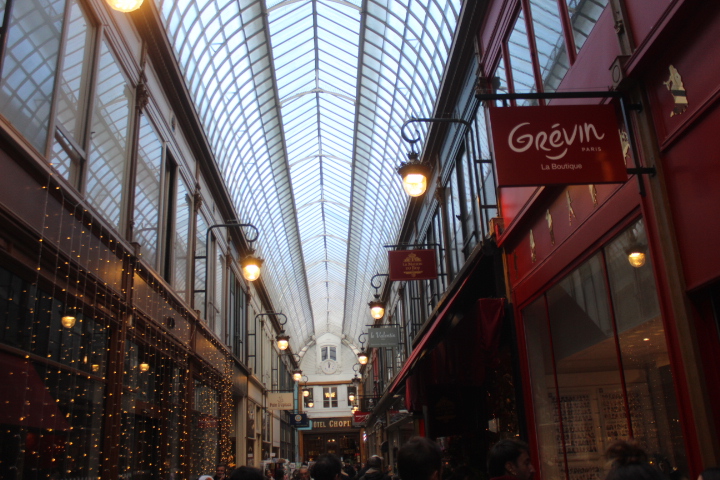
Paris wasn't always full of wide, tree-lined boulevards and uniform buildings. Before Napoleon the Third commissioned the renovation of the city, the streets were narrow, winding and cramped. As the population grew through the end of the 18th century, the combination of carriages, feces, people, merchants and rain made traversing the passages a stressful experience, not for the faint of heart.
The emerging petty bourgeois class found this environment inconducive to spending, so demand was created for spaces that could allow for a mess-free shopping experience. And thus, avenues were cordoned off, privately purchased and renovated to allow for a typical glass ceiling and tile floors. This is the birthplace of the Covered Passages, otherwise known as Les Passages Couverts, covered alleys of shops and restaurants.
With the rebirth of the city under the Haussmann works, grand magasins, proto department stores at Les Galeries Lafayette, were developed and the majority of the passages couverts were destroyed, their use outlived. Nowadays, around twenty of the hundred and fifty that existed in 1850 (the start of the renovations) are accessible to the public. Within these living remains, there are not just fancy halls with expensive stores—in a tour of every passage couvert, you will find a reflection of life in the neighborhood you find it in. That being said, there are three major hotspots in the city where you can find open passages. These are the second arrondissement, the ninth and the tenth.
The Second Arrondissement
Those in the first and second arrondissements, immediately near the Tuileries, will be least surprising. You can begin at the Jardin du Palais Royal and take yourself north along the rue Vivienne, this will propel you through them all. Here you will find the famous Galerie Vivienne with its intricate tile floors and perfect continuity from shop to shop. The contents of the storefronts reflect the appearance of the passage: purely decadent designers and restaurants, high end furnishings and antiques. The nearby Passage des Panoramas is likewise stunning and immaculately tailored to fit the Victorian aesthetic. It is, however, far less strangled than the Galerie Vivienne: the shops contain oddities, old books and a menage of eateries.
The Ninth Arrondissement
The ninth arrondissement has exquisite charm—the Passage Verdeau in particular, hosts an assortment of cramped bookshops and quick-bite cafes, with gorgeous moulding and a glass ceiling that rivals the beauty of the Galerie Vivienne. The Passage Jouffery continues down from where Verdeau ends and is similarly delightful. The oldest passage in the style of iron-and-glass ceilings, it boasts essentially the same selection of shops, with some hotels and a large Kilo shop for avid thrifters added. Flew Craig, an AUP student, says these two are their favorites, "I think they're really pretty. It's nice to have a shield from the rain in the winter and let the sun shine through in the summer. It's a peaceful place to be."
The Tenth Arrondissement
The last notable part of the city for Passages Couverts is to the east, in the tenth arrondissement. Here, you will find marketplaces that probably don't fit your idea of what a Parisian covered passage should look like. This is typified by the Passage Brady—easily the most colorful you will see, with bright red, greens, and orange signage decorating the stalls. The smell is immediately exciting, it is full of Asian and North African eateries, with particularly good Indian food and an impressive selection of spices. Compared to the rigid neutrality of the Galerie Vivienne, it stands out in liveliness and culture.
The Passage du Prado is a different story altogether—it sits nearby Brady, but eerily empty, with many closed storefronts and liminal lighting. While the emptiness makes it perhaps a bit spooky, it hosts several affordable coiffures.
Learning to see the hidden world
The most popular of these “hidden passages” are certainly not hidden—at least not to the swaths of tourists that occupy them; but, the longer I stay in Paris, the more I find myself with my head down, walking fast, thinking unconsciously of the road I am on as simply an obstacle between myself and my destination.
As we become citizens of Paris, annoyed by the gaggles stopped in the middle of the sidewalk, there is a certain curiosity that we lose for this beautiful city. Operating like this, stuck in the daily grind of living, the entrances are sometimes easy to mistake for yet another particularly ornate door.