The Attention Economy and Its Big Players
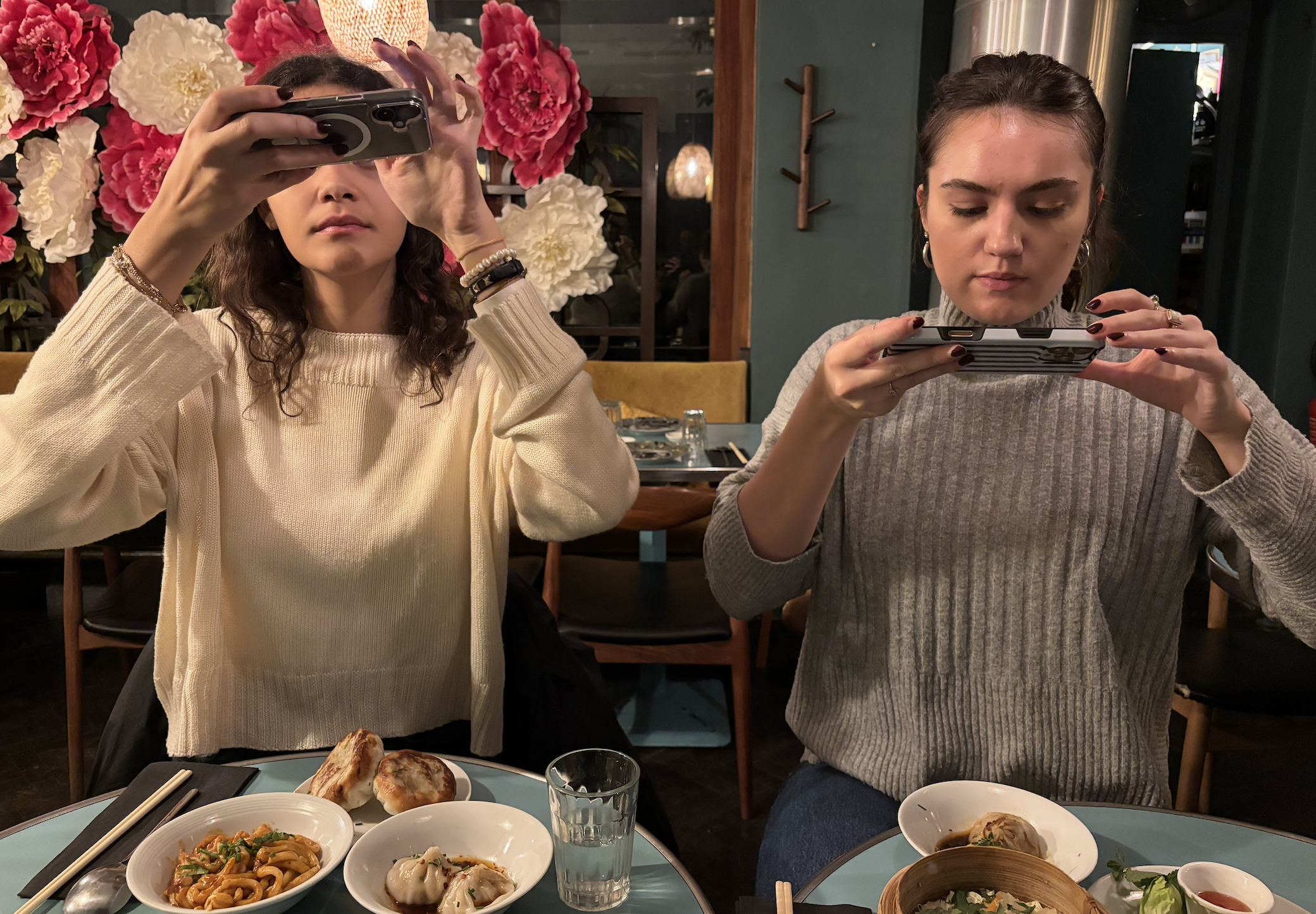
We live in an age where attention has become one of the most valuable commodities on earth. It is bought, sold, and fiercely competed over by corporations that understand that wherever our attention goes, money follows. From the moment we wake up to the moment we fall asleep, we are pulled in countless directions by notifications, advertisements, playlists, and endless streams of content. The result is distraction, but more importantly, a subtle but profound reshaping of how we experience the world and each other.
In this attention economy, consciousness can be directly translated to euros or dollars. We are increasingly unplugged from our immediate environment in order to stay constantly “connected.” Conversations with strangers have become rare. Chance encounters or meet-cutes are endangered, if not already extinct. Public spaces are quieter despite more people occupying them than ever because most of us are mentally elsewhere. Eyes are down, ears are filled, and minds are occupied. We spend more time on screens than ever before, and in doing so, we are slowly trading lived experience for mediated experience.
And yet, there is little evidence to suggest that we, as human beings, have fundamentally changed or that we have evolved past our need for connection. The desire for companionship, intimacy, friendship, and community remains deeply embedded in our biology. Studies across psychology and sociology continue to affirm that human beings are, at their core, social creatures. Our biological and emotional wiring has not suddenly shifted in the span of a decade or two. The idea that people no longer want connection is not supported by serious academic research. There has been no sweeping conclusion in scholarly journals declaring that humans have outgrown their need for one another.
The appetite for meaningful relationships remains intact. So the question is why, despite that enduring desire, the visible expressions of it appear to be diminishing. Why are people socializing less or in less varied ways? Why are marriages and long-term partnerships being delayed? Why do we see fewer informal gatherings, fewer overlapping friend groups, fewer environments where strangers interact freely? Why has the simple act of striking up a conversation with someone new become, in most environments, a deviation from normal?
Public life offers clues. In cafes, on public transport, in parks, and along city streets, people are present but often unavailable. Eye contact is fleeting. Conversations between strangers are rare. Even within groups, attention is often divided. Understanding this shift requires looking at the systems and structures that compete for our attention. Because if the instinct to connect is still there, then the more pressing question becomes what, exactly, is getting in the way?
Social Media and the Substitution of Human Interaction
Social media platforms have transformed how we communicate. They have enriched our lives and allowed for instant connection across distances that were once insurmountable. Yet with their increasing prevalence in society, they have also redefined what connection means. Where once we might have struck up a conversation with a stranger in a café, on the metro, or in a grocery store, we now have phones. Potential moments of spontaneity are now filled with scrolling.
Online communities have, for many, become substitutes for physical ones. People invest time and emotional energy into digital spaces on forums, comment sections, or in group chats, believing that these environments replicate or even replace local, in-person communities. Schools, sports clubs, volunteer organizations, workplaces, and extracurricular groups have historically been the backbone of social life, offering interaction, companionship, and shared experience. In contrast, online spaces often lack the depth, nuance, and teachability of face-to-face engagement.
This shift has consequences. When interaction becomes curated and mediated, we lose the elements that make human connection meaningful: the awkwardness of small talk, the vulnerability of meeting someone new, the richness and sentiment of shared physical presence. Social media offers connection without proximity and communication without emotional investment. It is efficient and important in maintaining relationships that otherwise would suffer, but often these connections are surface-level and shallow. Replacing in-person interaction with controlled engagement narrows the range of human experiences we have and how meaningful they are.
Headphones and the Soundtrack of Isolation
If social media occupies our eyes, music and personal audio occupy our ears. The rise of streaming platforms and wireless headphones has made it possible to carry a personalized soundtrack everywhere we go. This, on one hand, can be seen as enriching. Music can inspire, comfort, and energize, while podcasts can inform and entertain. But constant immersion in audio may come at a cost.
Headphones have become a near-permanent fixture in public life. On commutes, in queues, while walking down the street, grocery shopping, etc. In almost every shared space thinkable, many of us are plugged in, creating a private auditory bubble. This serves a purpose in shielding us from the noise of urban life, from unwanted interruptions, from the unpredictability of public space. But it also then must distance us from our surroundings. When we are constantly listening, we are less likely to notice the sounds of a city, the tone of a conversation, or the subtle cues that could invite interaction. We are less approachable and less inclined to approach others when listening. A simple exchange such as a comment about the weather or a shared observation becomes extinct when one or both parties are sealed off.
This constant access to curated audio reduces our appetite for other forms of engagement. Why strike up a conversation when a podcast is waiting? Why sit in silence or observe the world when music can fill the gap? The result is a form of passive consumption that replaces active participation. We are entertained, but we are also disengaged.
Advertising and Manufacturing Desire
Underlying both social media and personal audio is a more pervasive force: advertising. It is the engine of the attention economy and the mechanism through which attention is monetized. When it comes to our attention, it is relentless. We are marketed to constantly on our phones, on billboards, in apps, in emails, in the very platforms we use to communicate and relax. Advertising is woven seamlessly into the fabric of our daily lives. It follows us, surrounds us, adapts to us, and learns from us.
At its core, advertising shapes perception as much as it promotes products. Marketing companies rely on instilling a narrative of lack or less-than. We are told, implicitly and explicitly, that we are always one purchase away from improvement, whether that be to become more attractive, more successful, or more fulfilled. The message that what we have is not enough is persistent. This constant exposure fosters a state of low-level dissatisfaction. We browse products not out of necessity, but out of habit. We scroll through curated lifestyles and aspirational images, saving items we may never buy but feel compelled to want. Consumption becomes the primary solution to every problem or trouble one experiences.
In this industry, attention is directed toward a hypothetical future, one in which our needs are finally met, instead of the present. The irony lies in that this future is perpetually deferred. The cycle of desire and consumption is self-sustaining, ensuring that our attention remains captured.
Reclaiming Presence in an Age of Distraction
Social media, personal audio, and advertising create a powerful system that pulls us away from our immediate reality and sustains us elsewhere. They are not inherently harmful, and each offer genuine benefits and pleasures. The problem lies in the overwhelming dominance of these platforms and industries rather than their presence. When our attention is constantly fragmented and redirected, we lose the essential ability to be fully present. We miss opportunities for connection, for observation, and for participation in the world around us. We begin to experience life not as it unfolds, but as it is filtered through screens, sound, and curated narratives.
Perhaps the most insidious aspect of the attention economy is the creation of an illusion that time is scarce and that stillness or observation is wasted. In reality, we have more time than we often believe. What we lack is unclaimed attention more so than time. Reclaiming that attention does not have to mean rejecting modern technology or withdrawing from contemporary life. It requires awareness and moderation. It means recognizing when we are being pulled away from our surroundings and choosing, deliberately, to return and after how long. It means allotting time for unstructured interaction throughout the day. It means looking up, taking out our headphones, and engaging with the world and other people in it. The attention economy will not disappear as its infrastructure is too deeply embedded. But our participation in it is not entirely passive. We have agency in where we direct our focus, in how we spend our time, and in what we choose to notice.
I asked two participants, both women in their early twenties who are habitual users of social media and daily headphone wearers, alongside myself, to spend an entire day without either. No Instagram, no TikTok, no Pinterest, no Snapchat. No music, no podcasts, no quiet hum of our headphones. Just a day moving through the city and our daily lives, unplugged and attempting to gain more control over our attention. What emerged from their accounts was not dramatic revelation but instead a recalibration of awareness in how much each devoted time to screens and listening that was difficult to ignore.
Agnes MacGowan, a 22-year-old student at Parsons Paris, described her morning commute on the Paris metro as “uncomfortable and vivid.” Without headphones, the grinding of the train wheels, human sounds of itching, sneezing, laughing, rearranging, etc., felt intrusive and ignorable to MacGowan. “I noticed all of these disturbances and human behavior way more,” she said. She recounted making brief eye contact with a stranger yet was taken aback by how the interaction played out with her adhering to these abnormal restrictions. “We looked at each other and, as I felt myself gearing up to smile, I was instead shocked and maybe a little offended at how quickly and frantically he looked away at his phone when I was unable to do the same. Being so aware of making sure I stayed off my phone and without music, I was able to process it and was thinking about how much I mimic that same frantic avoidance of eye contact in interactions.” The day unfolded with similar moments for MacGowan where she was left feeling awkward or without knowing how to act while observing and absorbing her environment, such as when an overheard conversation almost made her laugh out loud. By evening, she described a realization that time felt longer, even when watching a movie, but less restless and exhausting as it does when she scrolls social media. “It was more like I had actually been somewhere all day and that is why I was tired,” she said. “Like I had used my brain differently… efficiently.”
Cadence Hofton, a 21-year-old undergraduate student in Paris, experience was less reflective as she took the abstinence as an opportunity to fill her day with activity. She described being “bored” in the morning hours alone in her apartment and a consistent urge to reach for her phone until she left. “I didn’t realize how often I check my phone and open social media without thinking, even while doing other things like when I was cooking or writing my thesis,” she noted. Yet as the day progressed and she surrounded herself with friends, the impulse to be on her phone softened. Hofton remarked on the same heightened sensitivity while commuting to the cafe where she met her friends for lunch. She described being able to really enjoy and appreciate the conversations she had at lunch and throughout the day because “they were the only thing filling her time and requiring thought,” she said.
Neither account suggests that a single day is enough to undo the habits of the attention economy. But both hint that so much of our environment is overlooked and that the conditions for connection persist. In a world that is constantly competing for our attention, choosing presence may be one of the most radical and liberating acts available to us.