Are You Allowed to Talk to People on the Metro?
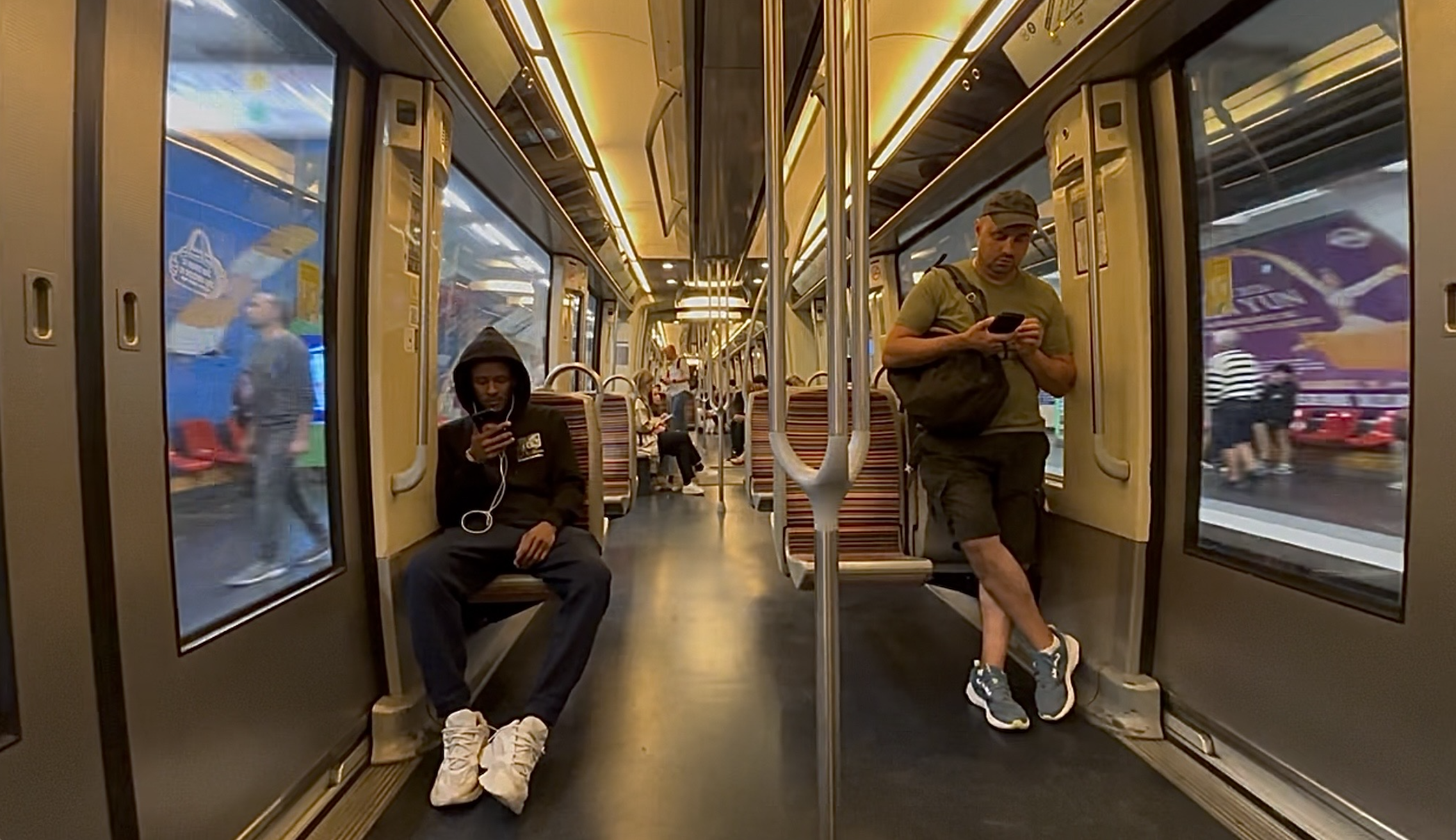
Every morning on the metro, the same quiet ritual plays out. We stand shoulder to shoulder with strangers, packed in by rush hour, and do our best to ignore each other. Eyes drop to phones. Headphones go in. Sometimes we’re inches apart, face to face, and still avoid eye contact, lost in whatever’s playing in our ears. Most people hover somewhere between looking neutral and slightly annoyed. It’s an unspoken agreement: we’ll share space, but not presence.
So when my editor asked me to break that rule, I felt a wave of dread, made worse by my very limited French (all quoted conversations below are translated into English). The assignment sounded simple: talk to people on the metro and see what happens. I tried twice on Line 8, once at 8:30 a.m. on my way to class, and again at 4 p.m. heading home. The reactions alone could have been the story. Some people even looked at me like I had just killed their cat.
On my morning ride, I ran into a friend on her way to a 9 a.m. class. I told her what I was doing.
“Oh my god,” she said. “You’re so brave.” After that, she was stuck with me. This felt like something better done with backup. We started small. A woman in perhaps her 70s stood nearby: slicked-back bun, oversized glasses, a long puffer coat, hands resting on a grocery trolley. She was tapping at her phone aggressively, wired headphones in. “Excuse me,” I said.
She looked up. I told her I liked her glasses, figuring a compliment was the easiest way in.
“Thank you,” she replied, and almost immediately put her headphones back in, eyes dropping to her screen. Over in seconds. But still, I did it.
Next, we turned to a woman our age who had just gotten on at Madeleine. I complimented her pants, asked where she got them, then explained my little experiment. She didn’t hesitate, smiley, open. “Sometimes I just wear my headphones with nothing even playing,” she told me. “Just to avoid being approached by men. If I ignore them, it doesn’t seem as rude. I can just say, ‘Sorry, I didn’t hear you.’”
Yet not every attempt landed as successfully. Later, I said “excuse me” to a woman in her late 50s. She didn’t respond at all. I gave up quickly, looking back down at my notes app, not because I desperately needed to take note of this interaction or else I would forget, but because the silence felt so awkward. I could feel that my face was red, and I wondered if anyone around me caught that.
To test the limits of metro kindness, my friend suggested an experiment: I “accidentally” dropped a stack of papers from my bag. They scattered across the floor. No one moved to help.
On my way home, I waved at a toddler in a stroller. His mother smiled. I told her that her son was adorable and explained my experiment. “Usually I get really nervous when he starts crying,” she said. “People around us look really bothered. And when the metro is crowded, I feel bad for taking up space with the stroller.” I asked if anyone ever helped her. She laughed. “People always offer my son a seat, which is very kind. Things like that always restore my faith in humanity,” she said. “But in my head I’m thinking… what about me? I want to sit too.” As we spoke, three people around us briefly looked up from their phones, then looked back down.
Later, I asked a man in his late 30s, blue button-up, leather briefcase, for directions, even though I already knew where I was going. He helped easily, without hesitation, then asked why I was in Paris. I was caught off guard; I didn’t expect the conversation to go that far. So I made something up, said it was my first time, that I’d always wanted to visit, and that I was here for a week. We both wished each other a good day. A small interaction, but a pleasant one.
Another man, around the age of 25, heard my friend and me debating who would be our next culprit and said, “I can help.” We sighed with relief. He reflected on something more personal than the others: “Just yesterday I was on the bus with my dad; he’s always really chatty. I don’t know why, but I always feel a bit embarrassed. He’ll just yell things out loud. He always says, ‘the world is going to hell, people don’t love each other anymore.’” He paused, then added, “It makes me wonder if people used to talk more on public transport before iPhones. I always notice older people talking more than everyone else, but maybe it’s just that they don’t care anymore. They talk when they want to.”
From what I can see, it’s not that people are cold. If anything, the system depends on a kind of mutual understanding: don’t stare, don’t speak, don’t intrude. These rules keep everything running smoothly. They also make it quietly lonely.
I decided to do a little research on this. A 2025 study published in the Journal of Transport & Health analyzed over 24,000 Seoul workers and found longer commutes (>60 min) significantly increased loneliness risk, up to 49%. Interestingly, public transit users fared better than private drivers, suggesting shared spaces like trains hold untapped social potential, even if rarely used.
That potential is easy to miss. Phones and headphones offer an escape from the unpredictability of real interaction. Why risk awkwardness when you can scroll?