SGA's New Town Hall Initiative
In the nearly two months that the Student Government Association (SGA) has been in session, the majority of each 80-minute meeting has been spent discussing budgets presented to the Senate. Frequently, the sessions go slightly over time to accommodate clubs that are in the middle of their presentations, even as senators file out of the room to rush to their next class.
The AUP Student Constitution, which outlines the structure of SGA, states that the role of a senator is to "represent the interests of all their constituents by bringing concerns to respective committees, and departments" (Annex II, section 2, subsection 2.1, sub-subsection 2.1.4). The AUP website goes further to explain that senators are able to bring these concerns to the Senate floor. But, with the aforementioned dedication of meetings towards budget-related issues, the question begs: when does the Senate discuss issues of the student body?
A New Initiative
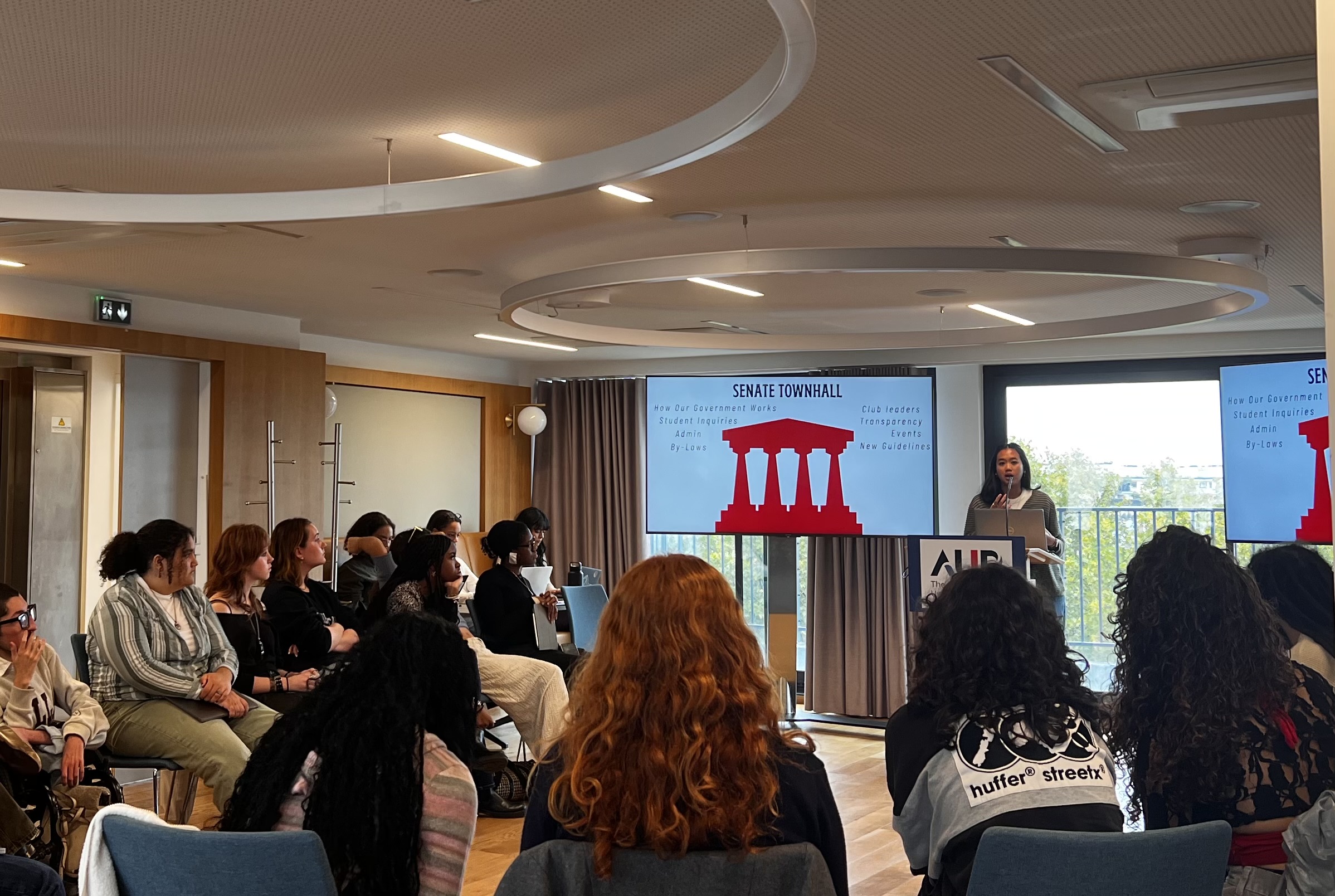
On October 15, 2025, SGA Undergraduate Vice President Asha Wiratnanto presented a new and developing subset of SGA, titled "Senate Town Hall."
In a sit-down interview, the Undergraduate Vice President explains that she is currently experimenting with the concepts during the "Open Forum" portion of the Senate meeting. She admits that, because the issues raised during the open forum typically revolve around the topics discussed in that Senate meeting, it limits the possible concerns brought forward.
“The whole point of open forum is to encourage senators to advertise their events, bring up student concerns, bring up concerns with the Senate sessions and things that are going on within our Senate sessions. But a lot of the concerns that come up are very dependent on what happens in the Senate sessions.”
- SGA Undergraduate Vice President Asha Wiratnanto
She later explains that she is planning on actively developing it during the rest of the semester, citing the upcoming senator bonding day later this month as an opportunity not only provide senators with extra training, but also as a way to hear their opinions on topics that should be discussed during the Town Hall sessions.
How these plans of communication within the student body will be enacted is still a main question. The Senate Town Hall is set to take place during a designated Senate meeting, with the session entirely allocated towards topics such as student concerns and promoting transparency on the developments of SGA and its committees. These Town Hall meetings would happen around twice a semester, hopefully starting at the end of this semester, with a main outlet of promotion being Engage. In Asha’s eyes, the platform allows information about on-campus events to be "readily available for all students," citing a recent event where a student who is not involved in SGA attended an SGA Judiciary Committee meeting, as she saw the event listed on Engage.
Ultimately, will this lead to restructuring of SGA as a whole? Possibly. Asha was very clear that the idea of change is one that is very important to her and was a core reason for her running for SGA Undergraduate Vice President. As a former senator herself, the hands-on experience of being in the Senate has allowed her to discern the weaker spots of SGA as a whole, understanding that change and restructuring might need to happen to move on from solely discussing budgets, making way for bigger discussions and creating opportunities to hear student concerns.
“I think it's great that I'm hearing all these like senator concerns already in open forum and I can tell that if I were to create this like more like open platform and space for senators to be able be able to voice their concerns about a specific topic, I feel like we could definitely be getting somewhere very positive and make better change for the Senate.”
- SGA Undergraduate Vice President Asha Wiratnanto
Despite the “Town Hall” being a main initiative of Asha’s, she has other plans for SGA. Following the theme of communication, she describes the idea of a “Presidents Circle”, which would consist of the different club leaders at AUP, where they can discuss plans for the semester. In her eyes, this would create an environment for team building and community building, allowing clubs to interact with each other and bounce ideas off each other.
As both senators and club leaders would be present at these meetings, it would help facilitate stronger ties between Activities & Club Committee (ACC), the executive board, senators and the clubs coming to Senate. The lack of communication is a problem she has noticed to be a constant over the course of her time in the Senate.
Her main focus as Undergraduate Vice President is to facilitate a bridge of communication, noting the difficulties and intricacies of completing the task.
“It's really tough because being able to streamline information throughout many different platforms and then having to tell many different people is challenging. I think this is one of my biggest challenges for sure. I think that creating these spaces to talk will definitely give people the opportunity to be able to speak up and essentially to communicate. That's the biggest goal for me”
- SGA Undergraduate Vice President Asha Wiratnanto
Group Discussions
The topic of reform has also been discussed amongst the senators. During the "Open Forum" of the November 5 Senate meeting, one senator voiced their concerns on the voting procedure, posing the question: Should we make our votes anonymous? Their main concern was whether senators are able to act on their opinions when it comes to voting.
Multiple Senators chimed in, with an opposing voice stating that as senators, they should have a "backbone" and be able to stand by their opinions. Executive and admin members of the SGA also chimed in, responding by explaining that, as elected officials, the votes of senators should be made available to the constituents. Vice President for Student Services and Security Marc Montheard, who was present at the meeting, later stated that "at the end, we should be able to know who voted for what, because this is the duty. You’ve got the power [and this is] the responsibility [that comes] with the power."
What to Expect Next
The emphasis placed on budgets has left various members of the Senate, varying in hierarchical status, questioning the structure of the Senate as a whole. While the consensus seems to be that more time in Senate sessions should be allocated to other pressing topics concerning the student body, this era of potential change has sparked other concerns of Senate structuring within the senators themselves. As the semester progresses, students will be able to discern for themselves whether adequate change has been made in order to make their voices heard.